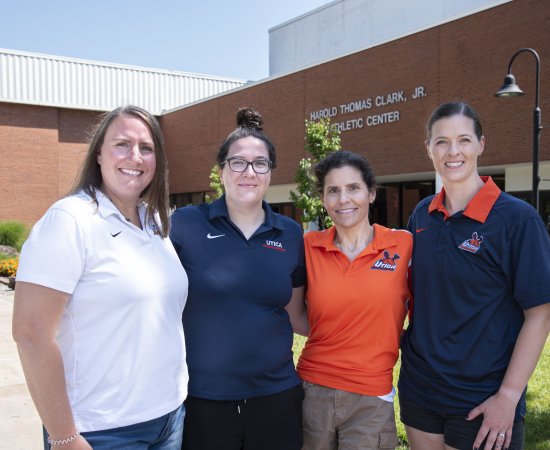
Office Spotlight: Athletic Training
Dedicated employees across the University are advancing the mission and future of Utica through their wide-ranging contributions, talents, and passion....

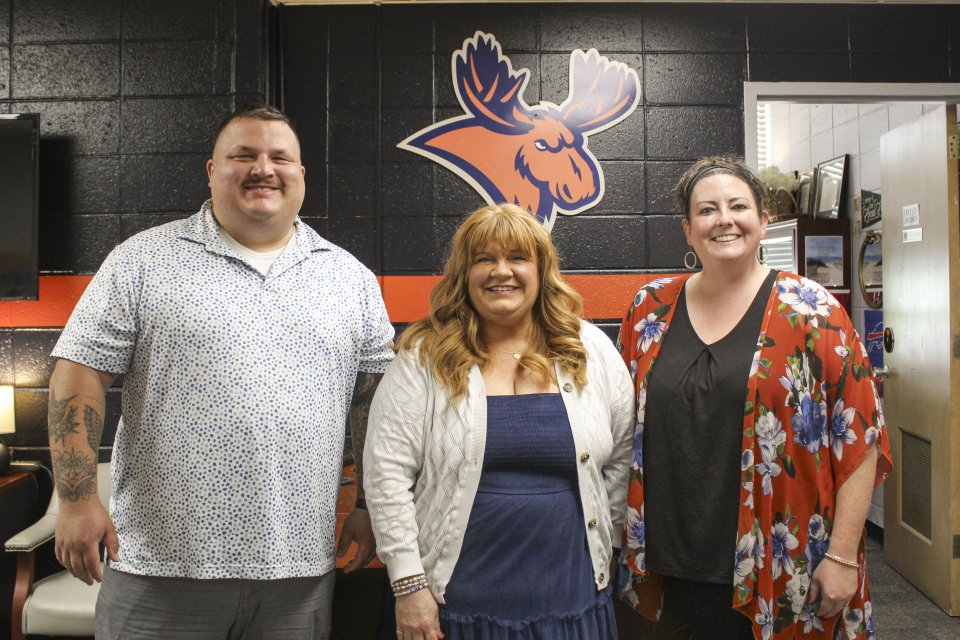
"I feel like we’re focused and we’ve created momentum for going forward. And the people here really care."
Dedicated employees across the University are advancing the mission and future of Utica through their wide-ranging contributions, talents, and passion.
In this Q&A, we sit down with the team in the Office of Student Involvement and Leadership: Assistant Director of Leadership and Special Initiatives Allison Copperwheat, Assistant Director of Campus Engagement Alexander Hodkinson, and Associate Dean of Campus Engagement Lauryn Moore.
Q: Your office has undergone a bit of a metamorphosis in recent years, as reflected in the name change from Student Living and Campus Engagement to Student Involvement and Leadership. Can you talk a little about that?
LM: This is actually a very exciting time for us because we just reimagined ourself less than a year ago. We got to sit down and ask ourself, What do we want to be? We don’t want to be seen as the junk drawer where you can go to just to get Water Safari tickets and a stamp. We want to help our students find their home, find their place, find their people, and have that connection outside of the classroom. We believe that student engagement and student leadership development happens outside of the classroom in ways they might not expect. We see our role as offering any and all experiences for them and making it sound fun. So we’re constantly creating new opportunities to get students involved. And then the other major piece is we’re identifying leaders and building them up. Adding student leadership into our name, that to me is the meat of who we are. We want you to be involved, we want you to join clubs and orgs, but now what? (As a student), what can you do with that, and where can it take you? How do we cultivate you to become a leader? How do we get you to advance ideas? How do we get you to be an advocate for your group? I don’t want to speak for Allison, but she has created a great new program that we’re rolling out this fall, where basically students are going to have different checkpoints to becoming a student leader.
Q: I noticed that on the board out in the hallway. As I understand it, it’s a leadership program that is mapped out over the student lifecycle.
AC: That’s correct. Basically, it assigns different checkpoints to becoming a student leader. For example, the first year we want students to get involved by being a class officer or, even, just joining a club or org. And we want to make sure they attend the Involvement Fair and they’re going to a bunch of the different leadership workshops. We kind of gear it to a three-tiered (approach), learn, lead, and then what is your legacy as a student here? I feel like a big part of leadership training is finding your place and learning who you are as a leader. By year two, hopefully they’re already being elected to a leadership position, either within their club or org or Student Senate or both. As an aside, we’re also changing the structure of Student Senate a little bit just to make it more representative of our campus. In your junior and primarily your senior year, you’re going to learn about how you connect the skills you’ve acquired back to your future career, working with the Thurston Career Readiness Center. And also, the skills they’re learning in the classroom we want to connect back to this leadership training as well. It’s all intra-connected. When I think about my own leadership experience, I learned so much from being a student leader. Those are the things I always come back to.
LM: And part of becoming the upper-tier of the leadership positions is becoming an RA or Orientation mentor. Knowing the students who we’re putting in those positions have learned how to become a leader and then most importantly they’re teaching now, for example, our new sophomore OMs how to be an effective mentor – how, you might be having a tough day in the 90-degree heat, but how to put a smile on and make sure you’re connecting with a first-year student because that one conversation may make or break they’re entire time here. It’s not just signing the paperwork with Student Employment and now I’m an Orientation mentor. It’s putting the work in every day and making a difference on this campus because you love it here and because your Orientation mentor made an impact on you and now you want to do the same.
Q: Besides this new leadership training approach – and of course a new name – what other changes are on the horizon with your office?
LM: The Involvement Fair is a perfect example. Historically, it’s been on the third or fourth week of classes because we’ve held it along with the Majors and Minors Fair. Our students this year were vocal about it being held too late into the semester. They want to make those connections earlier. They (initially) wanted us to have it the first week of classes, but we talked and felt the second week would work better. The student voice is No. 1 here, so if students are telling us, ‘This is too late in the semester,’ we’re going to teach them how to come together as a group and with Student Senate, put (a proposal) together that we can push forward, and make sure their voice is heard.
Another example is our students are getting really strategic in how they advocate for themselves and for resources. UAB, our activities board, is doing assessment, even while they don’t call it that. They log attendance at every event, and now they’re able to show with data if a student goes to a UAB event, 90 percent of them return for a second event. So now when they’re standing in front of the group that’s allocating money, they can say, ‘Here’s actual data to back up that our events are working and having an impact.’
Q: Changing gears, what drew you to Utica University and this office in particular?
AH: In a professional capacity, I missed all the excitement that I experienced as an undergraduate here. I was in the corporate world, and I was looking for something different career-wise. Working in a hive, working on a busy campus was something that drew my attention. And being involved when I was an undergraduate, I thought it would be a good overlap for what I really enjoyed as a student and who I am as a person. When I saw the job posting, I took a pretty big jump. I had just finished my master’s in a different field, but I thought this would be a good fit, and it’s worked out so far.
AC: I came here from Oneonta. I worked at SUNY Oneonta and Hartwick. I started here in Student Employment. I transitioned over here to this office, and it has been a great fit. Interestingly, my educational background is elementary education. I went to Syracuse University. My career goal was to be an elementary school principal. When I graduated, I became an Orientation leader that summer, and I really loved talking to the new students. Through that, people were like, why don’t you become an RD and you can get free tuition and a free apartment while you get your master’s? I thought, that sounds like something I could do for a year or two while I complete graduate school and move on. And then four years later – which was my RD experience at SUNY Oneonta and I loved every minute of it – I went to a conference at Syracuse, I met some people there, and they wanted me to come there and be the Graduate Assistant for Leadership in the Office of Residence Life. So after I wormed my way into that graduate assistantship at Syracuse, I was like, ‘Okay, I guess I don’t want to be a principal at an elementary school anymore. Now, I’m just using the skills I learned in elementary ed and applying them to first-years in higher ed.
LM: I started as a Success Coach here in 2010. I have an aunt, Linda Culyer, who taught here, and she sent me the job description in the mail, called me, and said, ‘You’re going to get a piece of mail I want you to look at.’ I opened the envelope and pulled out the description, which she had cut out of the newspaper, and said, ‘Okay. Maybe.’ I was working in customer service, miserable, and figured I’d just apply for it and see what happens. Now, I can’t believe there was a time when I didn’t work here. Just naturally from relationship building, I would start to get pulled onto committees, like if there was a new initiative happening. And I’m a firm believer that the relationships that you make in your professional career kind of lead you to where you belong. So when this position opened up, I think it was just more of a natural fit.
AC: And I will say, coming here from a higher ed background, never would I imagine that Lauryn doesn’t have a higher education background. She’s truly a natural fit for student affairs work.
LM: I think I was young enough when I started – I mean my students coming in were a couple years younger than me – where I got to interact with them in a way where I was just where they are a few years earlier, I totally know how you’re feeling, I know you’re overwhelmed, and I think they saw that as genuine because I really, truly cared about them and I had just gone through it myself. I try really hard to still keep that mindset even though I’m way older than them now.
Q: Is there an aspect of your department's work that you believe people wouldn't know about?
AC: I think it’s all the behind the scenes work. Like a lot of offices, we get asked all the time, ‘What do you guys do over the summer when there’s no students there?’ The summer is when the planning happens. I don’t think people fully understand how much planning and preparation we put into the year and into all of the programming that we goes on during the course of the academic year. They just think this is the Office of Fun. There’s a lot of work that goes into that. It’s very carefully planned fun, and there’s a strategic side to it. We’re always looking at everything we do through an assessment lens.
LM: Even something as simple as the holiday dinner. This year, we want to make that an even better tradition. We’re going to do an inaugural tree lighting. We’ll have a huge tree downstairs in the lounge. We’ll have holiday ornament-making, a hot cocoa bar, and when dinner is ready upstairs, Damian (Boehlert) is going to open the doors and ring a bell for everyone to go upstairs, which is silly, but we’re just trying to make everyone feel at home celebrating traditions. There is a ton of planning that goes into that. To most, it might look like we threw an elf hat or reindeer antlers on someone and called it a day, but the planning for a large event like that – particularly as it relates to the question of, ‘How do we get everyone involved?’ – begins weeks and months in advance. We’re constantly juggling how do we make everyone feel happy and seen, which I think we do pretty well, but it requires constant coordination. And it’s a really good feeling to put all that work behind something and have it go off without a hitch.
AH: We’re the powerhouse behind student events, but I think what maybe doesn’t get recognized as much is just how much informal mentoring we do with students. A lot of time when we meet with students, whether it be event-based or club-based, we end up addressing more of their concerns than just programming and activities. We get a lot of unplanned meetings with students.
Q: What about the University’s mission and who we are as an institution most resonates with and inspires you?
AH: I came here as a student not knowing what I wanted to do, and I spent a lot of time bouncing around different programs. But in between all of that, I found a strong sense of community here, where even through the uncertainty, I never questioned whether this was the right place for me.
LM: I love the tenacity – both our students and the institution. We’re going to do everything imaginable to make sure our students have an amazing experience, whether they’re in the classroom or lab, on the athletic field, or just trying to get an event or idea off the ground. They work hard, and they see and recognize the staff and faculty here who are working hard to get it done. We’re just tenacious.
AC: I remember looking at our billboard recently while driving somewhere around Utica, and it really caught my attention. It said, ‘Your future is here.’ I really liked that message of insinuating that we’re the place where you’re going to build that future that you want and the place where you belong and can call your own. I know that that’s not our mission statement, but I just saw that it resonated with me. And it’s true. We’re building a lot of things that are five and 10 years out, and we’re building momentum. Even in our office, we have a lot of things brewing that are several years out. I know the past couple of years have been rough, but I feel positive coming here every day.
Q: What has been most meaningful about being part of students’ experiences at Utica?
LM: We get to see students coming in on Move-In Day, and we see them come out the door at Commencement. What an amazing full circle. And to see students who said, “I can’t do this anymore,’ and to have the opportunity to work with them and see them persevere it just gives me chills. We get that really unique position where we see their first day and their last day and every day in between. Our students are amazing. They’re kind. They’re intelligent. They’re resilient. They speak up for what is right. They truly impress and motivate me every single day. It makes everything worth it.
Q: What excites you about the University future?
AC: Everything. I feel like we’re focused and we’ve created momentum for going forward. And the people here really care. I’ve been at places where this is a job. What I love the most, and this may sound cliché, but I never feel like I’m going to work here. I never have to force myself to want to come in here every morning. It’s not that there’s no work-life balance, but I feel like here I can incorporate my life into my work and my work into my life, and I feel like that’s a really good fit for who I am. And I don’t know if I’ve answered the question, but I feel excited about the future and excited to be part of it.
Q: What are ways in which other offices can support your work?
LM: We are a small team of three. When we send out calls for people to support events, whether it’s Moose Movers on Move-In Day or volunteers at the Holiday Dinner, having people sign up not only makes things run smoother, but more importantly, it means so much to students to have participation from different offices and areas. Anytime we can get more volunteers, it’s great.
AC: And we’re always looking for faculty and staff who are interested in being advisors to clubs.
Q: What’s a fun fact about your office of team?
LM: Well, for one, Trax lives in our office. I don’t know how many people know that.
AC: And we have all the old Traxs downstairs – ghosts of Trax past.
LM: Al is kind of a fun fact unto himself – that one of our team members was not only a student here, but probably one of the most involved students that ever went through here and is now trying to create that experience for our students. It’s cool to have someone who has that perspective and who’s lived it – literally – to the point where he’s got the moose tattooed on the back of his leg.
For a general list of frequently used logins, you can also visit our logins page.