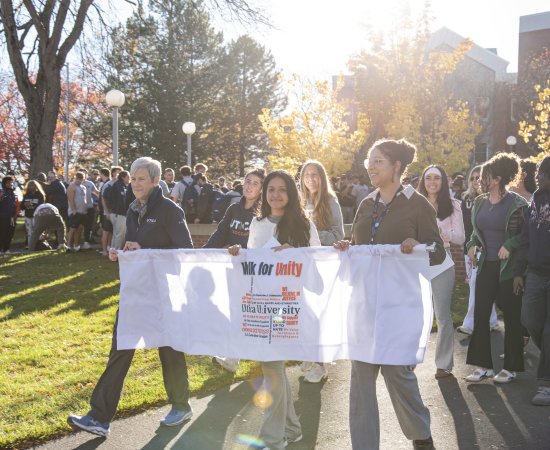
Stronger Together – Unity Walk 2026
Putting feet to pavement amid the golden rays and the autumn colors as rich and multiple as the backgrounds and...

"...they don’t realize how much medical knowledge we actually have and how frequently we are health advocates for the students."
Dedicated employees across the University are advancing the mission and future of Utica through their wide-ranging contributions, talents, and passion.
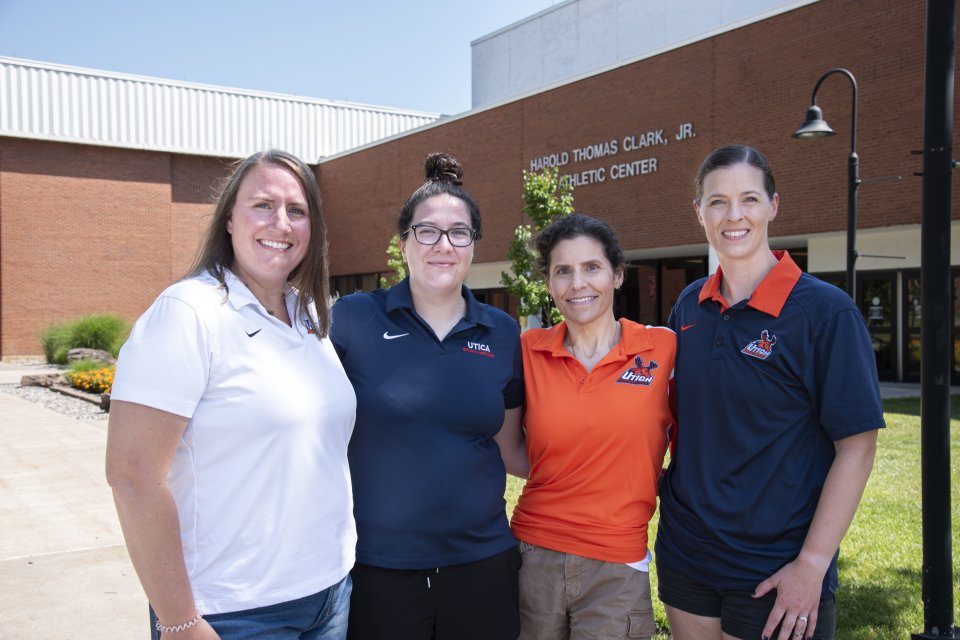
In this Q&A, we sit down with the University’s athletic training staff, Dawn Corbin, Jessie Foote, Gwen Murphy, and Joann Zazula.
Q: You are a team of four, supporting twenty-five sports across the fall, winter, and spring seasons. How do you divvy up those responsibilities?
JOANN ZAZULA (JZ): It depends on the season. In the fall, Dawn and Jessie are just football, and they handle the madness of that, and the rest of us sort of divide and conquer. So we don’t always overlap during the day, especially when we have 7 a.m. hockey practices and 8 p.m. soccer practices.
GWEN MURPHY (GM): We have assigned sports, but there are a couple that are completely shared. So for example, I do women’s soccer, gymnastics, and men’s lacrosse, but then Joann and I will share volleyball, field hockey, cross country, tennis, and golf. And then when we transition into winter sports, and there’s that overlap period, we’ll all have our assigned winter sport.
Q: What drew you to Utica University?
JESSIE FOOTE (JF): I grew up in Westmoreland – just down the road. I graduated from college, saw the just opening, and was like, I’d love to work near home and stay near my family. And when I met (Dawn, Gwen, and Joann), it was a really nice fit. And all the people here are great.
DAWN CORBIN (DC): I’ve always worked with football wherever I’ve been, and I wanted a head football position. So when I saw (the football) position open here, I immediately applied. I was at Shorter University in Georgia before I came here. I hate the cold – go figure.
Q: Is there an aspect of your department's work that you believe people wouldn't know about?
GM: I think a lot of people think we’re personal trainers and strength and conditioning coaches, and they don’t realize how much medical knowledge we actually have and how frequently we are health advocates for the students. For example, we spend a lot of time translating (diagnoses) and helping with referrals and doctor’s appointments and all of that. I think for a lot of the students, this is their first time going to a doctor without mom and dad, and so we help smooth that over a little bit so that it’s less intimidating.
JZ: With the incoming students, they usually don’t have much of an idea of what we do, so we have to explain that we’re here to help them. You don’t need to be afraid to come to us. Some athletes have never worked with an athletic trainer before – and same goes with parents. They don’t always understand who we are because we’re not physical therapists and we’re not doctors and we’re not EMTs, but we have a nice little realm of all of it, rolled into one profession.
JF: Our role varies from being almost parental figures to some athletes when they’re dealing with an injury to handling emergency situations on the field – and everything in between. And then there are the general day-to-day conversations of, ‘How are you doing? How are classes going?’
Q: And especially during the summer, you’re heavily involved with the new student intake processes in terms of student-athletes’ health records, correct?
DC: Absolutely. Right now, we’re processing all of their physical forms, their emergency contacts, their insurance information. The NCAA requires sickle cell testing for all student-athletes, so at the moment we’re spending a lot of time explaining what sickle cell (disease) is. We spend the summer doing all of that hand-in-hand with them because it’s different from the requirements of the general student population. And then we’re spending a lot of time checking in with our returning athletes.
Q: And like every other office on campus, you probably have people in your lives ask you what you do when students are gone for the summer, right?
GM: I just had someone ask me last week, ‘You’re off for the summer, right?’ We’re never off. It gets a little quieter, and there’s more paperwork and phone calls than face-to-face interactions with students, but there’s a ton of behind-the-scenes work that hopefully sets us up for a good preseason and then fall, winter, and spring seasons.
Q: What about the University’s mission and who we are as an institution most resonates with and inspires you?
JF: At the college I attended, there was no support for athletics. I really love the support our athletes have here and that it’s a large part of the campus culture. That was also a large part of what drew me here.
GM: I like how integrated the school is with the community. I feel like there are a lot of businesses and industries that rely on the school for new employees. I really like how community-focused the University is.
DC: I agree. And I also like how the community supports our teams and then, in turn, all of our teams support and volunteer with so many organizations and causes in the community.
Q: What has been most meaningful about being part of students’ experiences at Utica?
JF: I think anytime I’ve watched them from start of an injury to when they get back on the field. I’ve worked with students who have gone extended periods without being able to play, and then helping them get back to doing what they love and are passionate about and seeing them have success, that’s what’s most rewarding for me. Whether it’s the first touchdown or tackle after an injury, I think I’m celebrating it more than they are.
Q: It’s interesting because in some regards your work is considered behind the scenes, if you will, but from a different perspective, you spend hours upon hours with these students and, in some cases, have more one-on-one interactions with them than even their coaches or professors do.
DC: I think a lot of people don’t understand just how much time we spend with them and how well we get to know them outside of just sports. I’ve been here since 2009, and in that time, I can’t tell you how many of their weddings I’ve been to and how many calls I’ve gotten when their kids are born. It’s a different type of relationship that we build with them while they’re here. They don’t just come to see us when they get injured. They come to us with their problems and they come to our little corner and just tell us about their day when they need to decompress. I don’t think they know they’re coming for their mental health, but they’re coming for their mental health.
JZ: The training room is a hang-out space. They'll come in there simply to get away from the pressures of balancing classes, practices, and just the demands of being a student-athlete.
JF: And often times, we see them at their most vulnerable. When you suffer a potentially season-ending injury, that’s a pretty vulnerable moment and they’re kind of leaning on us to help them through it – physically and emotionally.
DC: The (athlete-trainer) relationship is a different relationship than the athlete-coach relationship.
Q: What are ways in which other offices can support your work?
GM: I think the people here are great, but occasionally when student-athletes have had to miss time due to surgeries, we’ve gotten some pushback where they won’t accept the answer from us. They want to hear from the doctor – even though New York state says we are licensed medical professionals. So just having some more support and understanding when we reach out and explain the situation instead of asking us for a doctor’s note. We are never going to pull a student from class just for the sake of pulling them. The students know better than to even approach us about doing that. If we’re reaching out to a professor about a student missing class, it’s only because it’s medically necessary.
JF: If anything, we’re erring on the side of students going to class.
Q: What’s a fun fact about your office?
JF: We always have a stacked candy and snack drawer for students.
JZ: Dawn is the go-to whenever you’re looking for something specific. When in doubt, Dawn has it.
JF: She’s like a grocery store, hardware store, and craft store in one.
GM: Our office crushes in trivia.
JZ: The athletes are disappointed when we don’t post a question or poll of the day outside of the downstairs training room. We’ve been doing it for three years, and some students come in specifically to answer the poll.
GM: It’s sparked some spicey debates as well about some really stupid topics.
Q: What keeps you going?
GM: If you think of other health care industries, or even outside of health care in other areas of the sports realm, there’s nothing quite like what we do, in terms of the variety of setting and function on any given day. I like the variety and change of pace, season to season, and I especially like seeing the student-athletes grow. There’s not too many places where you get to see that.
DC: For me, there are a lot of things that are drawbacks. The hours are unconventional and usually long, but you have to weigh that against what you really love about the job, and I’ve always loved the relationships with the athletes. Those relationships are what do it for me.
For a general list of frequently used logins, you can also visit our logins page.