The Perfect Combination of Crime and Chemistry: Brayden McCaw ’27
Within the mystery scenario, students were asked to determine the identities of components of an unknown substance found at the scene of a suspected murder.
Who did it? Where? And with what?
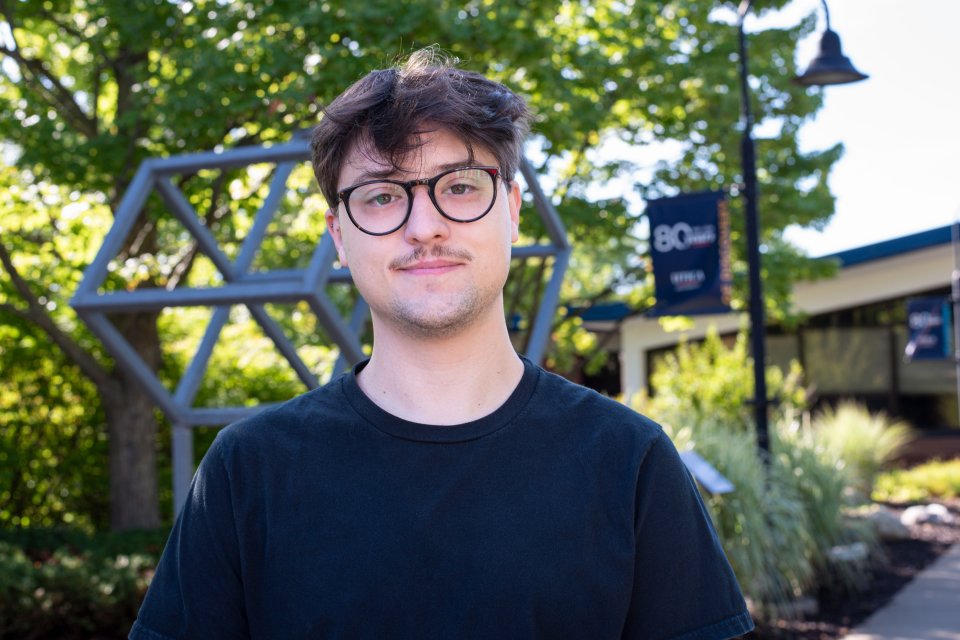
It’s not a game of Clue that’s afoot – but a murderous simulation dreamed up by chemistry major Brayden McCaw ’27 to help students uncover the substances used at the scene of a mysterious killing.
He’s been a health sciences major, a political science major, and a criminal science major before finding his calling in chemistry, proving that it’s okay to have a wide array of interests and worth it to give them all a try as you work to discover your path.
Growing up in Newport, New York, not far from Utica, Brayden had always found himself wanting to do everything.
“I wanted to learn everything and be everything,” he says. “From a lawyer, to a writer, to the president.”
In order to find the right match on his academic and personal journey, he just needed a little nudge.
“I wasn't really sure until I met my girlfriend, who pushed me to think about what it really was that would make me happy. I met Doctor Alyssa Thomas and Michelle Boucher in 2023 and immediately knew I was at home in the chemistry department at Utica.”
For someone who simultaneously wished to fight for justice in the courtroom while also writing the next Agatha Christie whodunit, it seems a perfect blend of all the fields that bring him joy to present his chemistry research in the form of a crime scene – one that he hopes keep his fellow students just as engaged and entertained as he.
“Dr. Boucher, who has been of my greatest supporter, sat down with me and we talked about all those different topics I was interested in,” he explains.
Knowing Brayden’s deep interest in forensics and talent for communication, Dr. Boucher tapped into her own interest in using forensic-themed case studies as hooks to get students interested in a lab.
“I have developed a number of lab modules on my own, and have published one, but had never really found a version of the TLC lab (the lab that Brayden developed) that I liked,” Dr. Boucher said. “And I did try for a number of years, but nothing really worked (chemically or thematically) the way I wanted it to work.”
A lab module is often a specific part of a laboratory setting designed for educational or experimental purposes. They vary in function, such as conducting experiments, facilitating research activities, or teaching concepts. In the Brayden’s case – all three.
Lofty Goals
When Dr Boucher presented Brayden with the learning goals of the lab she had worked on, and the story she had tried to develop, Brayden was immediately interested.
“He took the project and ran with it,” she says. “He developed the methods, the story, and the materials that became the TLC lab that we ran in Organic Chemistry class last spring.”
Together, Brayden and Dr. Boucher were looking to develop a lab module that could achieve multiple and lofty goals:
- Introduce Thin Layer Chromatography (TLC) to the students - a technique by which a chemist can take a small sample of a substance and determine, with the right conditions, how many unique chemicals are in the substance and, with a library to compare it to, even the identity of those chemicals.
- Help students understand the role of conditions (the method development that Brayden did was to find optimum conditions that would work all the time with the student testers) in this process.
- Determine a set of chemicals in each substance "found at the scene" that would both be ones that the students could identify and also would fit the story. “Again, part of that method development, and not an easy thing to do, fitting both the chemistry and the story,” emphasizes Dr. Boucher. “This was a hard thing to do, to find chemicals that were relatively safe but could be used for murder and would fit the story (i.e. something people could actually get) and would actually also work using conditions that were possible in our lab and that Brayden had to develop.”
- Had chemicals that would resolve (give the answer) using an instrument in the laboratory (the GC-MS, a chromatograph that uses a computer to identify from a bank of compounds), as well as develop the testing method for that instrument and the compounds he chose
- Develop a story around these processes and chemicals that would be entertaining.
“Brayden did all these things and then ran, in Dr. Curtis Pulliams' organic labs, the two-week lab module,” Dr. Boucher explains. “And it worked great!”
Scene of the Crime
Within the mystery scenario, students were asked to determine the identities of components of an unknown substance found at the scene of a suspected murder. Among the potential compounds were analgesics (pain relievers), as were some potential toxins (such as naphthalene).
In the first week, groups made up of four students were asked to determine a chemical library of TLCs. Each group was in charge of assigning different tests to each member, and each student runs their own TLCs and adds them to the group data set. By the end of the first week of laboratory, each group has a protocol and TLC library that they believe will work to separate an unknown mixture.
In the second week they are provided an unknown substance "found" at the "crime scene" and are tasked with using their developed method to determine what the unknown substance is.
Throughout the investigation, some groups discover they need to adjust their protocol to get good separation, which led to good conversations about polarity and this technique.
Once students believe they have positively identified the substances, they are able to move as a group to the gas chromatography-mass spectrometry stage. It is during this last phase of the laboratory, the instrument is introduced, building on the work they did with method development for TLC, and then their unknown sample is run.
“Dr. Boucher had previously done research work on TLC and its applications in crime scene investigations, and Dr. Curtis Pulliam LOVES GC-MS,” said Brayden. “And before I could blink I was learning the most interesting things from published nationwide experts in their field.”
He says the most interesting things to come from his research was learning just how many of the methods he had learned in previous courses applied to real world work.
“My experience with this research has shown that our students have a great interest in forensic science, and I hope that further development of labs in our department will encourage them to pursue their interests,” Brayden says.
The success of this unique lab module is not only a triumph for Brayden in its development, but, as Dr. Boucher points out, has the potential for use in teaching students everywhere.
Impact
“We need to run it at least one more year for reproducibility, but after that, it is very easily publishable,” Dr. Boucher says. “This would mean that it would become part of the chemical literature and could be used by other schools anywhere.”
She hopes that along with running Brayden’s module one more time, that the research can also be used to develop another new module.
“Brayden is very interested in other evidence, such as blood spatters, and I am hopeful that we might collaborate with others on campus to find a project of joint interest that could be used in the chemistry lab or another lab sequence,” she says.
It is hands-on experiences like this that help students become thinkers and doers, gaining the skills and the ability to apply them in ways that benefit both themselves with graduate or job placement, but also bettering the communities and world in which they inhabit.
“These experiences also help students see that they have worth beyond how they do on an exam,” Dr. Boucher explains. “Being a student is hard in ways that can be easy for us, who are well away from school, to forget. So often our worth felt defined by how well we memorized material for an exam. In the real world, however, we need problem solvers and creative thinkers, people who can engage with challenges and find solutions. Research gives students the chance to directly apply what they have learned in the classroom to real world questions or hands-on processes. It helps show why all that material that we teach them actually matters, and how it matters!”
More importantly, she notes, it gives students the opportunity to build resilience and to try and fail (research projects rarely work the first time) and to realize that the fun of science is trying and failing and then trying again.
“The most exciting thing about research is the points of ‘why did this happen?’ or the ‘this is great!’ and ‘what's next?’” she says. “It is the question, and the process of the question, as much as the answer. Sometimes students discover that while they might not be the best students in the traditional lecture classroom, they have the talent and the determination and the creativity to be fantastic researchers. If you have the desire to ask ‘why’ or think ‘what if’ and the tenacity to keep trying, you are suited to research, and these experiences let students see what they can do and who they can become.”
Support System
For Brayden, the entire experience has left him not only with a newfound appreciation for the skills he has learned and how to apply them, but with increased gratitude for all the people who made it possible for him to do so.
“I could not have done any of this without Dr. Boucher and Dr. Pulliam,” he says. “Not only were they with me every step of the way in the lab, but they encouraged me to really step out of my comfort zone. I thought that helping to teach this lab was scary enough, but with my advisors' support, I was able to (almost) confidently share my research with other students and professionals at the American Chemical Society conference in Atlanta this past March. I’m eternally grateful to my professors who made me believe in myself, our donors who gave us the opportunity to conduct our research, and of course my amazing girlfriend for making me get my butt in the lab even on my most anxious days. And a big thank you to the students that so patiently let me teach this lab!”
For a mentor seeing their student’s research brough to such successful fruition, the feeling is more than mutual for Dr. Boucher.
“I am incredibly proud of Brayden! Not many chemistry students are interested in laboratory development or creative writing, and rarely have we been able to develop classroom materials together from idea to fruition in less than a year. Seeing Brayden's hard work pay off in the spring was an absolute joy! Brayden is such a well rounded student, with so many interests across so many disciplines, and it is a privilege to be allowed to see him take ownership of all aspects of a project and help him turn concept to reality. I know that parts of the process, especially final poster presentations at the huge ACS meeting in Atlanta, were scary, but Brayden pushed through his trepidation and his poster was a huge success. Seeing that growth, that confidence, is part of what makes research with students so rewarding.”