
When a squeak is not just a squeak – Marshall Hildreth ’26
"Because mouse squeaks share similar productional qualities to human speech, they will contribute to basic research investigating the neurological basis of communication, as well translational research."
When one hears the squeak of a mouse in their basement, they most likely may be wondering how it got in there moreso than what the mouse is saying. But that’s exactly what researchers like Marshall Hildreth ’26 have set out to determine alongside colleagues and mentor Dr. Sarah Keesom.
“My research came about rather serendipitously, as Dr. Keesom graciously offered me the opportunity to conduct summer research on a question she has been wanting to answer for years: What do mouse squeaks mean?”
House mice use multiple vocalization types, including squeaks and ultrasonic vocalizations. A previous study demonstrated that female mouse squeaks possess longer-duration nonlinear segments, a type of acoustic variation, at a phase of the female reproductive cycle when they are able to become pregnant. This is potentially important information for listening male mice, but whether this acoustic variation actually affects male behavior is unknown.
“This led us to test the hypothesis that nonlinearities within female mouse squeaks convey reproductive information and influence male behavior,” Hildreth explains. “What I found most interesting about our research is that it is the first to demonstrate that male mice are attentive to nonlinearities within female mouse squeaks. Put simply, we supported our hypothesis that nonlinearities convey female mouse reproductive ability. This has now opened up a treasure trove of experimental questions and possibilities.”
Mice are used ubiquitously within labs around the world and are a key model organism in studying human pathologies.
“This is especially true for studying human communication disorders. Because mouse squeaks share similar productional qualities to human speech, they will contribute to basic research investigating the neurological basis of communication, as well translational research. For example, by shedding a newfound light on the meaning of squeaks, our research will help improve pre-clinical studies of human conditions that impact social behavior and communication, such as Autism Spectrum Disorder (ASD).”
For all the scientific revelations that this research has led to, it has done so thanks to the involvement of Utica University students such as Hildreth and Martinez who helped bring the research project to life. The duo both helped to take a method the team had read in a scientific paper and developed it for use in their lab at Utica.
“In fact, this project would not have seen the light of day without them,” says Dr. Keesom. “They helped to run the experiments where we played different types of squeaks to male mice to ‘ask’ the mice what a squeak might mean. Marshall and [fellow student researcher] Fausto Martinez also observed all of the experiments and analyzed the data, and they have both brought unique observations that helped to move this project forward. As we know, observation is the very start of the scientific process, so the more that we notice as a research team, the better our science will be. Lastly, it's also just more fun to include students!”
The team of researchers meet to talk about their results and read papers together in their weekly lab meetings, engaging in stimulating conversations.
“Science is best when it is shared!” Dr. Keesom emphasizes.
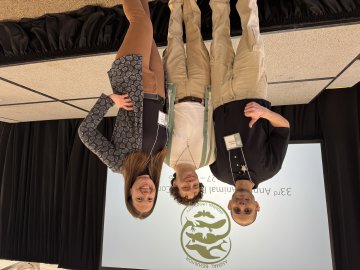
Hildreth and Martinez joined Dr. Keesom for the 33rd Annual Animal Behavior Conference in Bloomington, Indiana. Organized by The Center for the Integrative Study of Animal Behavior (CISAB), one of the top centers for animal behavior research in the world, the conference offers animal behaviorists like Hildreth and Martinez the opportunity to meet and present their latest research.
“Attending this conference allowed me to find community through science and to grow as a budding professional within ethology. Without Dr. Keesom, none of the above would have been possible.”
Growing up in Fonda, New York, upriver from the Capital District, Hildreth’s pathway to Utica’s Animal Behavior program was anything but traditional.
“Originally, I was pursuing a Bachelor of Arts in Political Science at Siena College, now Siena University, with an anticipated graduation year of 2020. With such a tumultuous year, I took a break from my academic career and entered the workforce. After working within an AmeriCorps position as a Community Outreach Coordinator, I realized a degree in political science was something I was no longer interested in. This watershed moment empowered me to go back to school for my ultimate passion: animals.”
A new journey meant a new path and Utica University not only held proximity to home in Fonda, but was a strategic location near two AZA-accredited zoos (The Utica Zoo and the Rosamond Gifford Zoo).
“Most importantly, the passionate Utica faculty who are conducting ground-breaking research.”
Something Hildreth says Dr. Keesom has proven in spades.
“Dr. Keesom was a guiding light throughout my research. Her passion and thoughtfulness were infectious, making for a smooth and welcoming foray into animal behavior research. Additionally, Dr. Keesom does not just advise, she cultivates her student’s academic curiosity and professional development.”
Walking across the stage in May 2026 to earn a Bachelor of Science in Animal Behavior ends Hildreth’s role in this research but the cycle continues as new students will join the lab and take up the reins, creating an ongoing legacy of minds committed to forward this unique research.
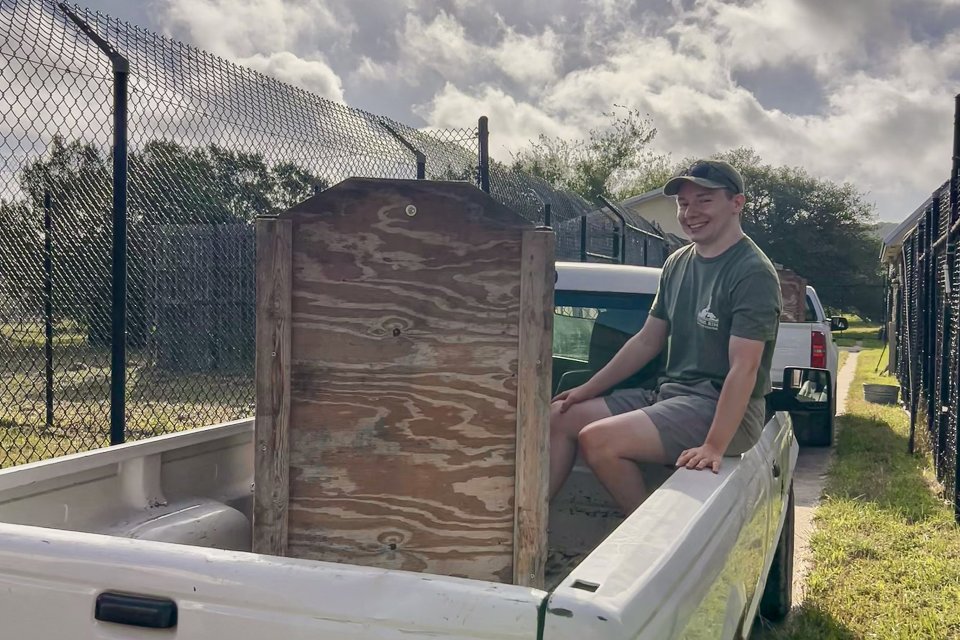
Meanwhile, Marshall is currently at Fossil Rim Wildlife Center in Glen Rose, Texas, interning within their Carnivore Department.
“I’m working directly with critically endangered American red wolves and Mexican grey wolves. Fossil Rim also has black footed cats and a renowned cheetah breeding program. After Fossil Rim, I’m hoping to attain a position that dovetails research and zoo animal husbandry.”
The skills Hildreth gained along the way at Utica, though, will go on forever.
“I will absolutely be utilizing the knowledge, skills, and passion I have gained through this experience on my journey forward. It seems like I’ve got ‘the bug’, or rather ‘the mouse’, as I hope to follow a path toward professional research, with ambitions to become a mammalian field ethologist. And while I may be moving on, I implore whoever may be reading this to keep their eye on the Keesom Lab; here at Utica University, great things come in squeak-sized discoveries.”
More Stories
“You’re part of our story.”
Crisp temperatures turned to a cozy October warmth as golden rays from the sun made for the perfect Autumn morning...

80 Years Later, Utica University Returns to Where its Story Began
Eighty years ago, the grand lobby of Hotel Utica was filled with community leaders raising a glass to a new...
Prospective Students Can Discover Utica at Fall Open House
Utica University will host fall Open Houses on Saturday, October 17, and Wednesday, November 11. Prospective students and their families...
I would like to see logins and resources for:
For a general list of frequently used logins, you can also visit our logins page.