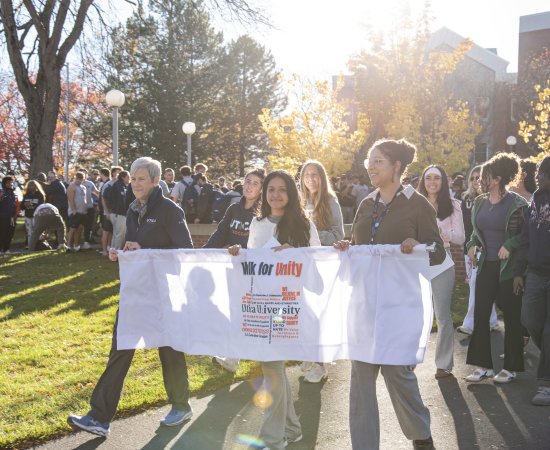
Stronger Together – Unity Walk 2026
Putting feet to pavement amid the golden rays and the autumn colors as rich and multiple as the backgrounds and...

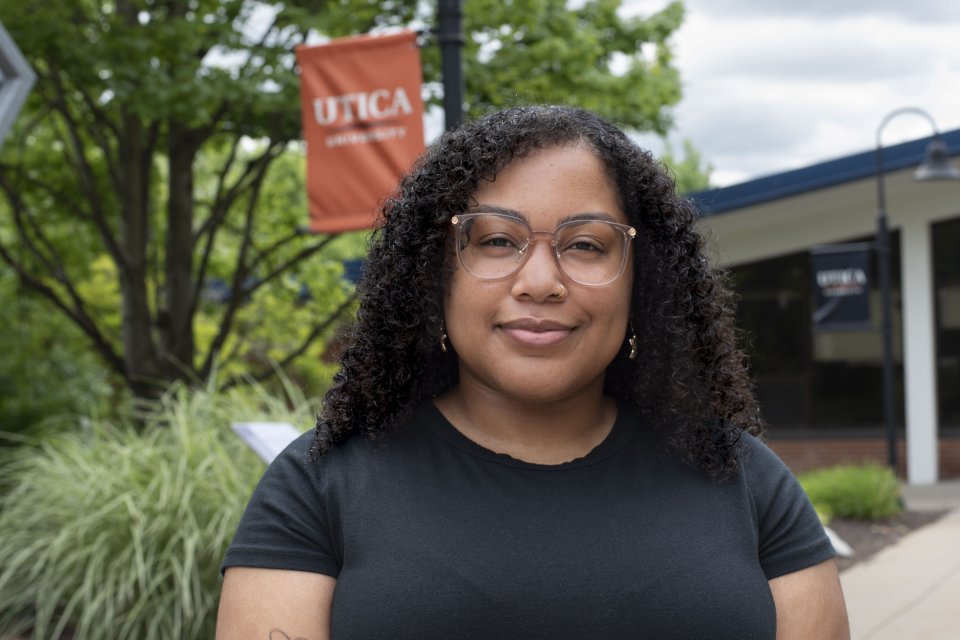
“I also saw the value in being a part of a team responsible for investigating clean and renewable sources of energy.”
Energy is depleted. Machinery can’t run. Grid’s can’t sustain. It wouldn’t take much time after that for communities to find themselves on the threshold of collapse.
Our entire modern world runs on energy sources, constantly racing to keep up with demand and maintain the daily flow. But what happens if those finite resources disappear? Global natural resource consumption is forecast to rise 60% by 2060, compared to the levels of 2020, according to the United Nations.
As the imminent danger of depleting energy resources becomes significant, there is an increasing need for clean sources of energy, something Chemistry major Nevaeh Scott-Dominguez ’26 hopes her research under the guidance of Assistant Professor of Chemistry Dr. Elaine Liu can help work toward.
Hydrogen evolution has gained attention due to its clean and stable water vapor byproduct.
“We are using the current model system around a naturally occurring enzyme called nickel-iron hydrogenase and tweaking its structure to find out if we can make a mimic that has increased catalytic activity,” Nevaeh says.
That enzyme is able to take two individual hydrogen ions (H+) and put them together to make hydrogen gas (H2) very efficiently and catalytically.
“A single enzyme can do this type of process repeatedly and indefinitely - it's like an assembly line for making and taking apart molecules,” explains Dr Liu. “Hydrogen gas is important to renewable energy because it is very efficient (a large amount of energy is produced per hydrogen molecule burned) and the only byproduct from the combustion of hydrogen gas is water, unlike fossil fuels that have a large number of byproducts that are damaging to the environment - the big one is carbon dioxide.”
The enzyme is great at making hydrogen gas, but isolating an enzyme can be quite difficult and enzymes tend to not work when they're taken out of their natural environment.
“The goal of Nevaeh's research was to make a smaller, synthetic version of the nickel-iron hydrogenase that could be used for generating hydrogen,” Dr. Liu says. “This would be easier and cheaper to make than isolating the enzyme and it has the potential to function in more environments than the enzyme.”
Choosing Utica University due to its proximity, smaller class size, and opportunity to do undergraduate research, the Utica native joined the lab because of her interest in learning more about spectroscopy, synthesis, and electrochemistry, finding that it brought not only opportunity, but purpose.
“I also saw the value in being a part of a team responsible for investigating clean and renewable sources of energy,” says Nevaeh. “Fossil fuels are finite and rapidly depleting, so any work we can do now to ensure we have clean and renewable energy for future generations is crucial!”
The research Nevaeh worked on required a number of advanced techniques.
“For example, all of Nevaeh's work occurred in the inert-atmosphere glovebox, which has a nitrogen atmosphere to protect the molecules and reactions from exposure to oxygen. This is a very common technique in the world of synthetic chemical research, like pharmaceutical and argochemical research, and a useful technical skill to carry forward into the work force or further studies.”
Perhaps more importantly, working in the glovebox empowers students in their sense of themselves as researchers and ownership of their work.
“Working in the glovebox can feel high-pressure, but with care and practice students become experts - they not only know how to use the glovebox safely and effectively, but they are also prepared to teach others to use it safely and effectively. One thing that students can struggle with is stepping into and embracing their identity as a "real" chemist or biochemist and working on projects and with equipment you would see at a large research university can help mitigate the imposter syndrome that is common among students at smaller universities like Utica.”
To date, several [NiFe]-hydrogenase mimics have been reported, but few demonstrated any catalytic activity; those that did were limited by high catalyst loading, short catalyst lifespans, and low turnover numbers. Previous research demonstrates that the H2 evolution by the [NiFe]-hydrogenase is the result of the redox chemistry occurring at the Ni(II) center.
“I found it most interesting that there are plenty of methods other than Nuclear Magnetic Resonance Spectroscopy and Infrared Spectroscopy to determine structural characteristics of a compound,” she says.
In her research, she used Ultraviolet Visible Spectroscopy, for example, to make fairly accurate predictions about the structure of a compound they had not characterized via X-ray Crystallography.
“Since the UV spectrum of the unknown compound showed vast similarities to the spectrum of a compound of which the crystal structure was known, we were able to predict structural similarities between the two compounds,” she explains.
And Dr. Liu was there for her, every step of the way.
“Dr. Liu provided guidance when I was stuck on a synthesis or characterization step and helped me summarize the most important talking points when presenting my poster,” says Nevaeh. “We also worked together to write up my abstract and poster.”
The admiration is mutual.
“She is an exceptional student and researcher, as well as a kind and thoughtful human being. Being a mentor to Nevaeh was a great experience,” says Dr. Liu. “Nevaeh started her research during her third semester at Utica and while she had only completed general chemistry at that point, she was driven and committed to learning anything she could. In the classroom and the lab Nevaeh always remained curious. She sought to find the connections and understand where her research intersected with her classroom learning. Watching her grow her understanding and build an increasingly nuanced understanding of her courses and her research was truly incredible to see as an educator.”
And while her research into Organometallics and work with the lab comes to an end with her graduation from Utica, she knows that the lab skills she picked up during her time in Dr. Liu’s lab has more than prepared her to continue research in graduate school. She also hopes that future students in Dr. Liu’s lab can carry on the work done thus far and the catalytic activity of the compounds she and the team synthesized, calling her research successors to action.
“Let's see if we can evolve hydrogen gas and begin to implement it into fuel cells!”

For a general list of frequently used logins, you can also visit our logins page.