
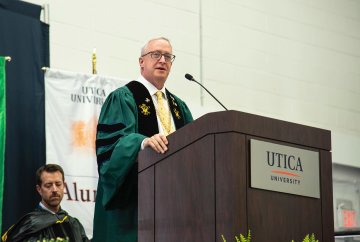
Parting Thoughts: President Todd Pfannestiel
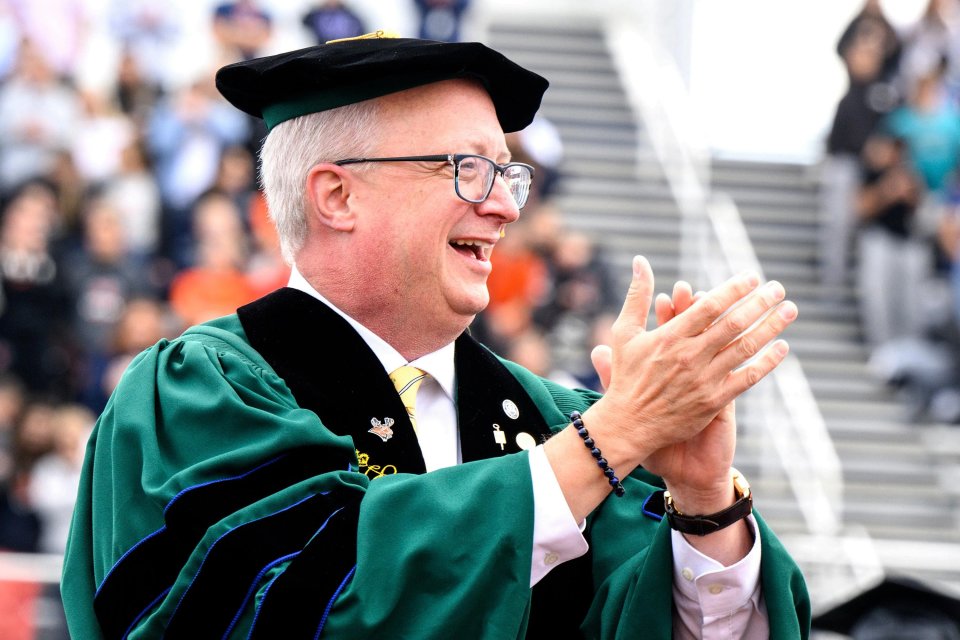
"I tell students all the time that you never know when you walk out the door, whether you turn left or right, how it’s going to change the course your life. You just don't know."
Dr. Todd Pfannestiel joined Utica University in 2018 as Provost and Senior Vice President for Academic Affairs. In 2023, he became the institution’s 10th President.
As 2025 draws to a close, so will Dr. Pfannestiel’s time at the helm of Utica University, handing the reins to Provost and incoming President Dr. Stephanie Nesbitt at the start of January 2026.
Utica Magazine sat down with President Pfannestiel, or “Dr. Todd” as he’s known by many, to discuss the journey that brought him to Utica, what he’ll miss the most, and how Boris Yeltsin, of all people, is responsible for his career path.
UTICA MAGAZINE: Let’s start with a little bit of background. Where did you grow up and how did you become interested in teaching and academia?
TODD PFANNESTIEL: I was born in Kansas, raised in Oklahoma and Arkansas. I thought I was going to be a journalist when I went to the University of Arkansas. Four weeks in, I did not like my intro to journalism class and dropped it. Looking back, it was an important lesson and is something I tell students today - your first semester is going to maybe be your roughest semester, because it's a real transition going to college. And let's face it, a lot of the introductory level courses aren't in depth. It's not going to pique as much interest as your junior and senior level courses will. So right, wrong, or indifferent, that changed my path. I was then an undecided student.
A class I absolutely loved, though, was economics. Another was history. As an undergraduate, I was extremely shy and withdrawn - the very definition of the phrase wallflower. I was walking down the hallway in the building that housed history. My favorite professor was the only other person in the hallway and was walking toward me. I had to say something, anything. When he said “Hey, Todd, how are you doing?” I responded, “Oh, hello. Dr Edwards, you know, I'm thinking about becoming a history major. Can I come by and talk to you about that?” I never meant it. Yet, the next time I saw him, he had all the paperwork to sign and I thought “Well, I guess I'm a history major now.”
I went on to Duke University and was studying Soviet Economics, which tells you how old I am, because the Soviet Union still existed. There were only three of us in that program, so you really got a lot of specialized attention. My advisor was close colleagues with a former head of a Soviet economic agency that came over to the US to give some talks, and we three students got to meet him.
He asked what I was thinking of doing and I explained that my advisor had me lined up to come over to the Soviet Union. This was when Gorbachev was still in charge, and they were going not only through Perestroika [the political movement for reformation within the Communist Party of the Soviet Union] and Glasnost [a 1980s soviet policy promoting openness and transparency in government and scrutiny of leaders by the mass media] but they were trying to transform the economy into more, I won't say capitalist, but they were trying to transform the economy. I had an opportunity to go over and basically do some grunt work on the books. But this gentleman tells me to watch carefully, that a lot of changes are coming to the Soviet Union. He explained that it wasn’t that I wouldn’t be safe there, but for a career in Soviet Economics, I should watch closely.
Sure enough, within a year, Boris Yeltsin is riding on a tank in Red Square, and the Soviet Union is being dissolved into the individual states, and here comes Russia. So, I'm like, "well, I guess Soviet Economics is not going to be my career after all."
I left Duke University knowing my love has always been history, so I went to William and Mary and pursued my PhD in that.
I tell students all the time that you never know when you walk out the door, whether you turn left or right, how it’s going to change the course your life. You just don't know. There is no way to know. I basically became a history student because I didn't know how to talk to my history professor when I walked down the hallway and I became a history PhD student because Boris Yeltsin hopped on the tank and rode it into Red Square.
UM: How long were you teaching before you moved to the administrative side of academia?
TP: It was around 1991 or 1992 when I taught my first class. I wasn’t yet a full-time teacher. My full time teaching career began when I went to Clarion University of Pennsylvania. I was a full-time faculty member for 15 years and a full-time administrator for five. So my full time teaching career was 15 going on 16 years, and then I became a Dean and a Provost and acting president for those last five years at Clarion.
UM: What went through your head when you stepped foot on campus for that first day on the job? Any fear or reservations as you came in?
TP: When I arrived to start, I remember how nervous I was because I had spent 20 years at Clarion University, and all of my friendship networks, professional and personal, were all there. My wife, Aimee, and I knew no one up here at all. And there is a comfort level, even for the challenges that my last University faced, to at least knowing what they are. You know what and who they are, the good and the challenging ones, and there's a comfort level there. Now I was coming to an area where I was going to have to reestablish my comfort level. So I was nervous. It's like starting all over at, wow, age 50. Thankfully, my wife is a strong support system.
UM: Was there a particular moment that put you at ease about being here?
TP: There's a broader feeling, but then there's a very distinct moment, and that was June 1, my start date, which also happened to be the regular date for the weekly President's Cabinet meeting. It was in the President’s Office and I came in and I sat at the long table amid others on the cabinet at the time, and, of course, [former Utica President] Laura Casamento. I was in a three-piece suit and they were all in summer clothing, laughing at me. Someone said “Todd, we know it's your first day, but my God, it's summer!” I realized, if they're going to bust my chops like this on Day One, then this is okay. So we laughed about that and we still do to this day.
I think it benefited me that I came in at the start of the summer. Not that being a Provost ever has any slow moments, but it's slower during summer. It allowed me to gradually get to know faculty rather than just immediately jumping into Faculty Senate or a full meeting over the summer. Having that gradual ramp-up, as opposed to showing up on September 1 or August 1 and having to do that, really let me get to know people, which makes you feel more and more comfortable, as they want to know you as a person, not just as a Provost. It made a big difference.
UM: In your role as Provost, how would you describe your working relationship with former President Laura Casamento?
TP: It was excellent. Laura and I had to develop a professional comfort level because you're the Number Two. Not that there were any challenging points, but I would simply say that Laura had to get to know me as much as I had to get to know her. I strongly believe that one of the jobs of a Provost is to protect the President. Now, Laura Casamento is the last person in the world who needs protection. I mean that with all professional affection; she’s a very strong person. But a provost still serves that role; to take heat. Laura needed to know that she could trust me to take that heat, and that I always had her back, and I always did.
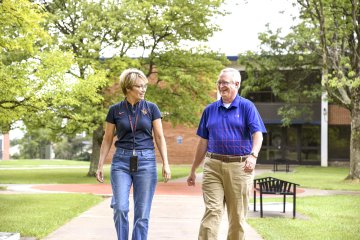
I would say that first year was a learning experience for both of us. It was great. But there was again a moment, and I wish I could pinpoint when it was, but clearly there was a moment when I realized that Laura and I had that professional relationship. She knew that all she had to do was pick up the phone and I would do everything she needed me to do, and I’d always have her back. Likewise, I knew behind closed doors that I could disagree with the President, because she knew that when the doors opened, I would support her 100% on everything that had to be done at this institution. I appreciate the fact that she respected that I might have a differing opinion, and she allowed me to present that. Sometimes she might agree with it, and she’d often ask me what I thought of something or what I would do in a situation. Laura understood that I had a really strong academic career and I was able to bring that experience to what we did.
She and I have both said that the professional relationship we had as Provost and President was probably unlike any other Provost and President you would ever find, and I think it was largely because we were not carbon copies of each other. She had all this experience and expertise in finance and fundraising and running a university that I needed to gain if I was going to someday be a president. Part of the reason I came here is because I knew I could learn a lot from her. Looking back, I think she also realized all the experience I brought to the room, having gone from adjunct instructor to assistant to associate to full, I had tenure, I had evaluated faculty. I could bring the academic chops that she was still developing, and so rather than being a carbon copy, or even opposites, we were a sort of yin and yang. It was a perfect compliment to each other. We did not replicate each other in any way, other than our absolute 100% passion for always doing what's right for this university. We brought different skill sets to make it happen, and I think that's how we also developed both a working relationship and a personal friendship, because we learned how much we rely upon each other. I would not have said yes to coming to this institution if Laura Casamento was not the president here.
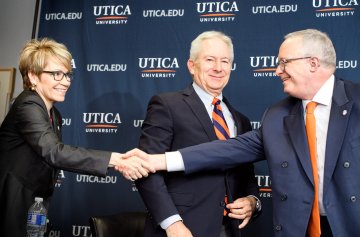
UM: What was that feeling like when you were offered the role of President?
TP: It was very meaningful, because so much of who I become as a leader is truly thanks to Laura Casamento’s mentorship, and anything I've done wrong is despite her mentorship. Any mistakes I've made are not because Laura did not move me in the right direction, but every positive thing, a lot of that has to do with her.
It meant a lot, because at that point, the personal friendship we had developed between our families to be her successor, as opposed to being anybody else's successor, was extra special.
UM: Is there anything during your time here that has carried the most weight for you, or was the most challenging moment in this role?
TP: Two things come to mind. The one's going to be the obvious, and was as Provost, not President, and that was the start of the COVID-19 pandemic. With Laura leading the way, and everyone else playing their role, we came through that with flying colors, no matter how challenging it was.
For me as President, the most challenging thing has been the financial challenges we faced, and the decisions that eventually I was the one who had to make regarding pay cuts and retirement freezes and furloughs and layoffs, and negotiations with faculty to get sacrifices there as well. These impact people's lives and there was not a day that I went home not fully aware of the impact of the decisions that I had to make. I know there's a lot of people on the team who'd say this was a collective decision. It may have been, but at the end of the day, I'm the one who greenlit it. I'm the one who said this is what we have to do, and so I take full responsibility for it. That was very weighty, because I never lost sight of the fact that we do have employees, that are part of our family, that live paycheck to paycheck, and the moment you start to impact a paycheck, in some fashion, you're impacting their life. If I'd been blind to that as we made these decisions; if I had just been looking at a spreadsheet and marking it down to zero to say "we’re good,’" then that would be a bad president. Yes, you need to reach the zero, but if you ever lose sight of the impact you're having on individual people's lives, then you shouldn't be a president ever.
UM: You seem to love interacting with students. How has that face-to-face interaction with students played a role in the decisions you make and your overall philosophy as President.?
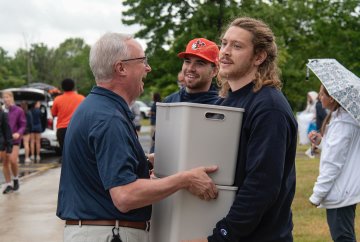
TP: Well, it's the relationships that make the job. No matter how challenging, it’s fun. So your inner compass helps you to make the right decisions the best you can, no matter how hard they are. What helps you after a tough decision, to visibly see why you do what you do, is the students.
Following a difficult decision, I’ll often walk the campus, because if I run into half a dozen students, it reminds me why I do what I do. Relationships in general are what makes me happy in terms of what I do. It's always about the relationships. I have relationships with colleagues, relationships with everyone from staff, faculty, employees, custodians, grounds crew, relationships with people in the community. But the most meaningful and happiest relationships I have are with the students.
And while a good inner compass helps me make the difficult decisions, I would still go home miserable because of the challenging impacts I’m having on people’s lives. If I want to go home with any modicum of happiness, I'm going to spend time with the students, because I know no matter what decisions I make on this campus, those students will always uplift me. That's how I felt about Clarion as well and the relationship I had there for 20 years. That's the hardest part to leave behind. The hardest part to leave behind here, as I move on, will be the students, period.
At Clarion, the students knew me as Dr. Todd, the faculty member who became a Dean or a Provost, but was still doing things with the students. Although students here weren’t going to know me as a faculty member, I think they still came to see me as someone that they could sit down with in the cafeteria, show me what they’re up to, invite me to student events. We laugh, we joke. So, it’s a different type of reason we find happiness together, but it’s still happiness and that makes me a little bit comfortable with the idea that as I go through another transition in my career, that the students will always be my happy point. I know whatever I do next, if there's students involved in it, I'll be okay. I'll establish new happiness, and I still have students at Clarion that get hold of me every year, saying, “I don't think you understand the impact you had on my life,” and then I start crying because they still remember me. When you have a students saying “you're always going to be my president no matter who's sitting in this office,” it's just so meaningful.
UM: Do you have a proudest moment from your time here?
TP: Wow. You know, every day there's a happy moment. And the fact that I can't sit here and say, “oh, when we put this building up,” I'm glad I can't, because otherwise it'd be like, "Yeah, three years in this role and a ribbon cutting was the greatest moment? What about all the other 1,000+ days?"
Maybe it’s boring to say the financial turnaround here, which everybody contributed to and made sacrifices to make happen but was necessary for the future of this institution. I'm really proud of how the team, for as hard as it still is, came together and made that happen. That was extremely meaningful.
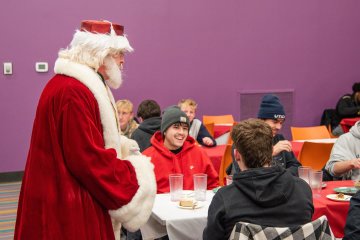
But then I also think back to moments when you almost can't contain your smile because of some small thing happening and it’s just so cool. There was a day outside of the Adirondack Bank Center and Nexus Center. I think they had two hockey games that day and everybody knows how much I love hockey. It was nighttime. I was coming down the back sidewalk, and I was wearing sneakers that say “President” on the back that [Special Assistant to the President and Secretary to the Board of Trustees] Anthony Villanti and his wife, Barb, got for me at Inauguration. I was wearing those that night, and I was probably a good 15 feet in front of a group of our students. It's already pretty dark, but they must have seen it, and I hear behind me that they liked the shoes. One of the students just yelled out, “that's my president!” And you just smile. That's pretty cool that students think of you that way.
Or after a theater production. One of my happiest moments was when they asked me to be in the production of The Wizard of Oz on campus. It was just a brief cameo during the tornado and they wanted to have me fly across the stage. It was great. Being backstage in the wings while the production was going on, knowing you’re about to go flying across the stage in a few minutes, and all the students back there with you, preparing, and saying hello in hushed tones – that was just wonderful.
Another moment is when Football Coach Blaise Faggiano invited me to the last practice on the field before they started the season. All the players took a knee and Blaise asked me to get them pumped up. The reaction they gave, it was just so incredible. And that’s the same anytime I’m visible around campus. That student reaction I get every time I'm out there, whether I’m bumping into students selling baked goods for a fundraiser at Strebel, having students ask me to do Tik Tok videos, it all makes every day a special day.
UM: How has coming from both academics and the your previous role as Provost informed your relationship with Provost and incoming President Stephanie Nesbitt?
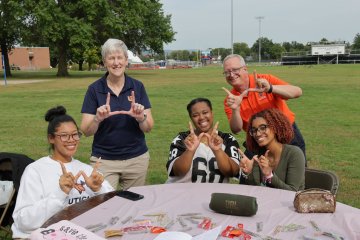
TP: It really informed it from Day One, because I knew Stephanie as a faculty member, then I was the Provost who hired her as a Dean, and I was the President who hired her as a Provost. So from Day One, I realized Stephanie and I were cut from the same cloth in terms of being born from an academic background, although she had a career prior to academics as well. I consider her an academic in every true, positive sense of the word. We've had a lot of shared experiences, even from different institutions.
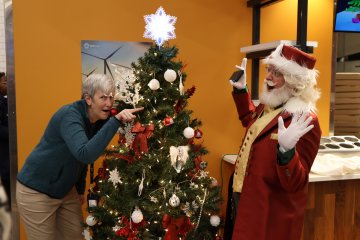
I feel like she has learned from me, but I've also seen, since we've made our transition announcement, her taking the lead. There's nothing left for her to learn from me and it's been that way now for several months. She is going to be so great at this position. Coming in here as we are turning the corner on these challenging times, she is the perfect person for this role. That has also made it easier for me to step aside because A, I don't want them going outside to someone else trying to rock the boat, and B, I know the amazing team that that we’ve put in place here.
UM: Any immediate plans after stepping down?
TP: The first thing I'm going to do, on the first working day after I'm no longer a president, is sleep in. I guarantee you I'm sleeping in on that first day.
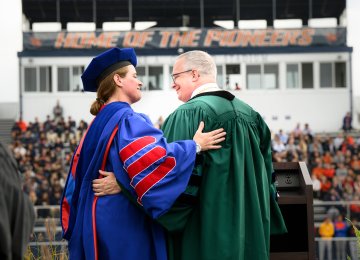
The second thing is, I want to be able to support my wife [Aimee Zellers, the Interim Associate Provost and a tenured Associate Professor of Philosophy at Carlow University, where she has taught since 2013] and see how her career develops over the next few months.
I have two books I've been working on for years. I'm going to get at least one of those two books done. Maybe I'll get both of them done. Maybe I'll just say I don't think I'm done in higher education yet. If other opportunities outside of higher present themselves, I'm curious. I'll have any discussion with anyone, but I have a hunch I'll still be in higher education.
I'm going to write those books. I'm not moving anywhere right away. I'll keep in touch with people here at Utica. I'll still come up to the cafeteria now and then and have lunch. I'll try to come out and support our students in their theater productions and their student functions and their athletics, obviously. But in terms of what's next? I’m not retired. If I had to guess, I imagine I'm going to be in higher education in some way. Could it take me elsewhere? Maybe. It could. But I think for the next several months, I'm going to sleep in a little bit. I'm going to be a stay-at-home dad to my two dogs, I'm going to write, and I'm going to work on those two books and get those published.
UM: What will you miss the most?
TP: Students. There's a lot of things but I'll miss them the most.
I come back to the idea that if I remain in higher ed, I'll have more interactions with other students in some way, but throughout the spring, for the students here in particular, I will still be interacting with them. These students will still see me around. I still have a whole group of students here that I will always consider my students. I'll be at commencement, because some of my students are going to be graduating. Students that came here as a freshman, that I met they and their parents, and I maybe played some small part in telling him why they should be here, I want to be there to shake their hand in that auditorium the day they get their degree.
More Stories
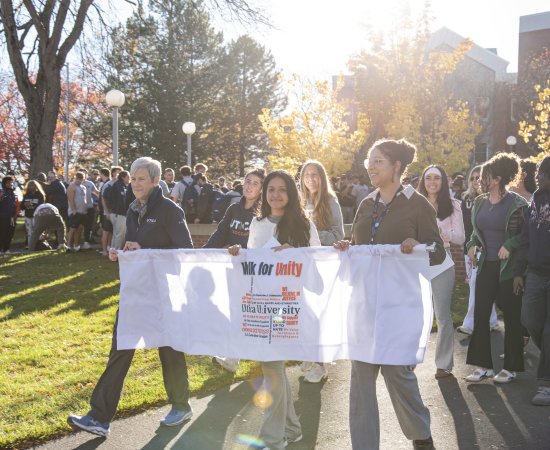
Stronger Together – Unity Walk 2026
Putting feet to pavement amid the golden rays and the autumn colors as rich and multiple as the backgrounds and...
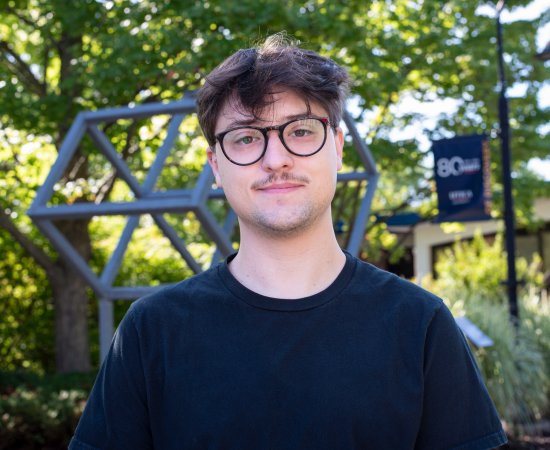
The Perfect Combination of Crime and Chemistry: Brayden McCaw ’27
Who did it? Where? And with what? It’s not a game of Clue that’s afoot – but a murderous simulation...
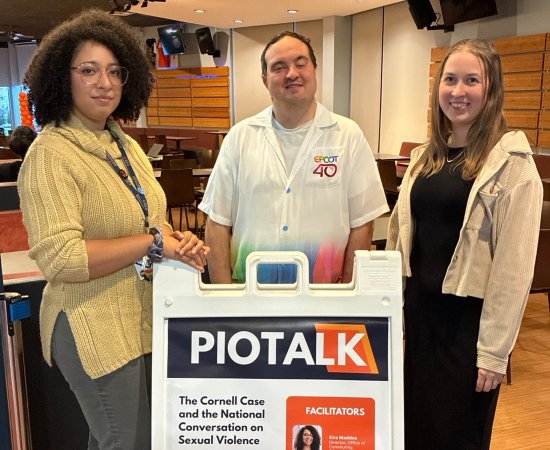
PioTalk opens conversation about sexual assault, violence, and building safer communities
On October 8, Utica University hosted a PioTalk discussion titled “The Cornell Case and the National Conversation on Sexual Violence”...
I would like to see logins and resources for:
For a general list of frequently used logins, you can also visit our logins page.