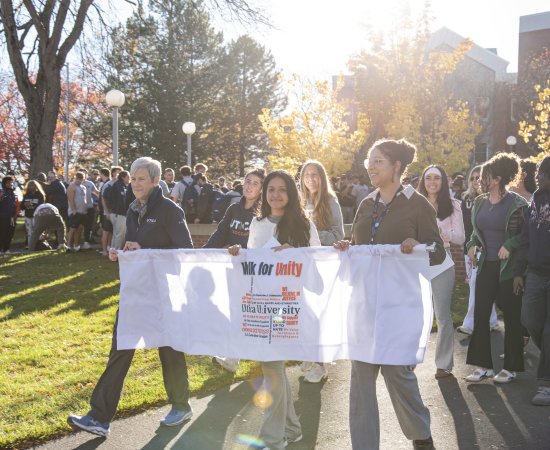
Stronger Together – Unity Walk 2026
Putting feet to pavement amid the golden rays and the autumn colors as rich and multiple as the backgrounds and...

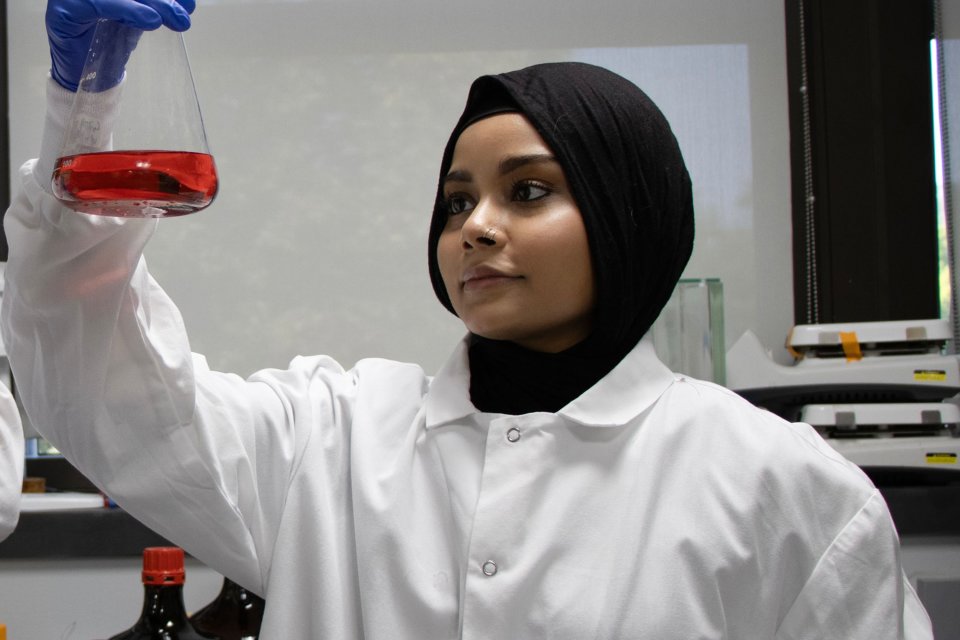
Photo Courtesy of Masonic Medical Research Institute
First-Generation Student Nurhaliza Syukur ’26 finds Affordable Opportunity at Utica
By any measure, it was a long and unlikely journey to her goal, but she made it.
A Rohingya refugee naturalized as a U.S. citizen in 2025, Nurhaliza Syukur ’26 was born and raised in Malaysia, coming to the United States in 2019. With aspirations of a career in medicine, she initially thought higher education might be out of her grasp financially. But it was at Utica University where she found both opportunity and affordability and now, as a biochemistry major, has been conducting research that has the potential to one day prevent fibrosis in organs.
“My parents were originally from Sittwe in Rakhine State, Myanmar. They immigrated to Malaysia to escape the genocide,” Nurhaliza says. “My father went back to Myanmar to see his family and was unable to return to Malaysia. After a few months, my mom heard that he had passed away when she was six months pregnant with me. I grew up with my sisters and my mom.”
During her senior year at Proctor High School in Utica, her teachers helped her apply to multiple colleges as she sought to become a doctor, but Nurhaliza was unsure what next steps she should take to get there. She eventually surmised that Utica University’s proximity to her home would allow her both opportunity to pursue her goals and the ability to continue helping out her mother with transportation, work, and appointments.
“I knew that Utica had strong nursing and science programs, and I really wanted to attend, but I thought it would be impossible for me to get admitted and continue my education there. I assumed that, being new to the country, I wasn't smart enough to go to a prestigious private college like that, plus I couldn't afford the tuition. However, I still decided to apply. When I received an acceptance letter from, I was overjoyed,” she says.
Her elation also came with apprehension, as she was unsure if she could afford the path to higher education. Those fears quickly dissipated.
“Fortunately, I received scholarships and a PASS STEM (Pathways to Achieving STEM Success) grant, which greatly relieved my financial burden and supported me academically, personally, mentally, and psychologically,” says Nurhaliza. “With their help, I started attending Utica as a biochemistry major. As a first-generation student, I wasn’t sure where to go or what to do, so I participated in TRIO Student Support Services, which significantly aided my personal and academic development.”
Though she had originally considered becoming a nurse or a doctor, after taking a healthcare course in high school, she came to the realization that it wasn’t the right path for her. She always enjoyed science, puzzles, and creating things, but wasn’t sure which scientific field would be the most useful, or what career might be the one she should pursue.
“I initially wanted to major in biomedical engineering to design devices like leg prostheses. However, Utica doesn't offer that major, so I chose biochemistry instead. My success coach advised me that it was the closest option and suggested pursuing a master's degree in biomedical engineering. I stuck with biochemistry and looked for other ways to apply the major.”
Even with the change in her career plans and the resulting uncertainty, she, over time, began to enjoy chemistry and the research, especially as she attended freshman seminars and learned more about the professors’ work.
“This introduced me to research and other opportunities. My advisor, Dr. Boucher, helped me understand the various career paths available with a biochemistry major and boosted my confidence. I used to be afraid to try new things or worried about failing, but Dr. Boucher helped me overcome those fears. Ultimately, I decided to become a researcher,” she says.
In 2023, she went on a trip to the Masonic Medical Research Institute (MMRI) through Pathways to Achieving STEM Success (PASS) – a small cohort of academically talented scholars receiving support programming as part of their university experience.
“That's where I learned about the summer fellowship they offer,” says Nurhaliza. “Since it's located in Utica and they have many interesting research labs, I applied to gain experience and develop my skills.”
From 2024 to 2025, Nurhaliza conducted independent research at Utica with Assistant Professor of Chemistry Dr. Elaine Liu and in Summer 2025 did her summer fellowship at Masonic, returning in the fall semester to complete her project as an intern. She’s been working in Dr. Jason R. McCarthy’s lab at MMRI where she undertook two projects this past summer.
“The first project involves the synthesis of potent small-molecule inhibitors targeting the myofibroblast transcription pathway, with the goal of preventing fibrosis in pulmonary tissues and, potentially, other organs in the future,” she says. “The other project focused on synthesizing nontoxic peptide-conjugated nanomaterials for drug delivery in iPSC-derived cardiomyocytes. Currently, I'm continuing to work on the nontoxic peptide-conjugated nanocarrier project, which is my second project.”
She hopes to see her work published before graduating but also sees intrinsic value in the effort she has invested even if that doesn’t happen on her ideal timeline.
“I'll still gain valuable skills, lab techniques, and experiences,” Nurhaliza says.
The experience, she says, has been nothing short of amazing. It’s something her time at Utica helped prepare her for so that she could make the most of it.
“I'm learning a lot and becoming more confident every day. I've had the chance to collaborate with other scientists and work on different projects, which has helped me gain more knowledge and skills. My professors at Utica and the independent research I conducted with Dr. Liu helped me get ready for research or fellowships outside of school,” she says.
With plans to pursue a Ph.D. program in either Medicinal Chemistry or Biochemistry, she has already applied to multiple graduate schools with the ultimate goal of working as a synthetic chemist. She hopes to design new drugs, molecules for drug delivery, and vaccines, as well as to conduct more research.
“I'm interested in working with the government, industry, or academia to gain experience and see which environment suits me best. In addition, I want to help people in need by giving to charity or donating, especially to those from low-income households or students like me, first-generation individuals, or refugees, to keep the cycle of support going,” says Nurhaliza.
For a general list of frequently used logins, you can also visit our logins page.