Program Details
Bachelor of Arts / Bachelor of Arts Degree • School of Arts and Sciences
Geoscience Major
Program Details
The bachelor of science option is designed to prepare students to work in applied earth and environmental science or pursue graduate studies in geoscience or related disciplines. A capstone experience such as a field course, directed research, or internship will be required of students receiving the B.S. to integrate liberal and professional study.
The bachelor of arts option is designed to provide substantial breadth in science preparation by also including coursework in biology, environmental issues, and astronomy, allowing students greater flexibility in tailoring the degree to meet their needs and interests.
Facilities and location
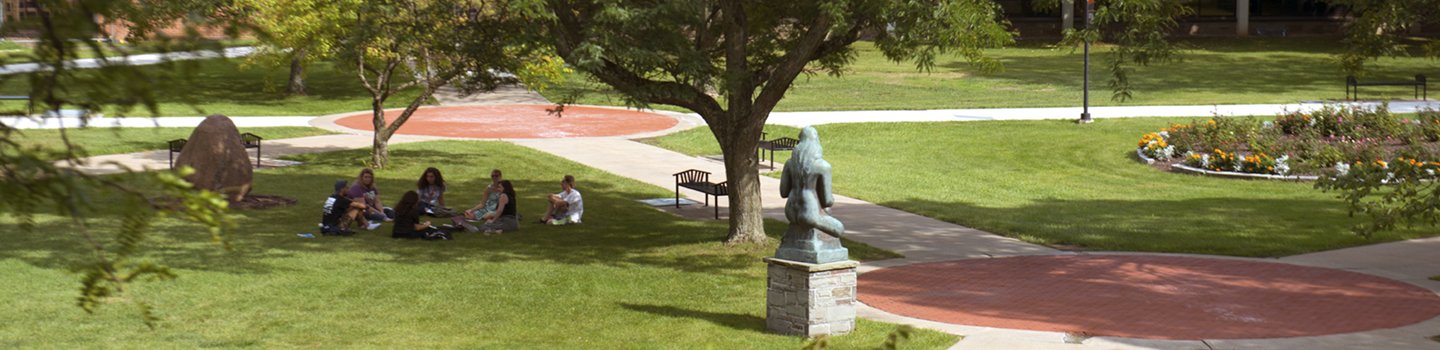
The Utica College campus offers excellent facilities and resources for the study of geoscience. Recent NASA and NSF grants have supported the installation of additional advanced technology and instrumentation (see below).
The proximity of Utica College to the Adirondack and Catskill Mountains, Mohawk Valley, Utica Marsh, and Great Lakes and Finger Lakes makes its geographic location ideal to provide ample learning opportunities vital to advanced learning in geoscience.
Technology and Instrumentation
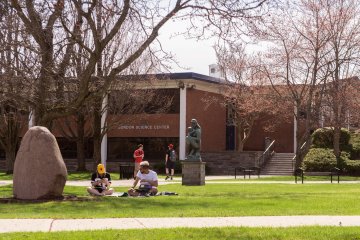
Housed in UC's Gordon Science Center, the Geology Department equipment includes:
- sieves,
- a Ro-Tap shaker,
- hydrometers,
- a current meter, and
- microscopes
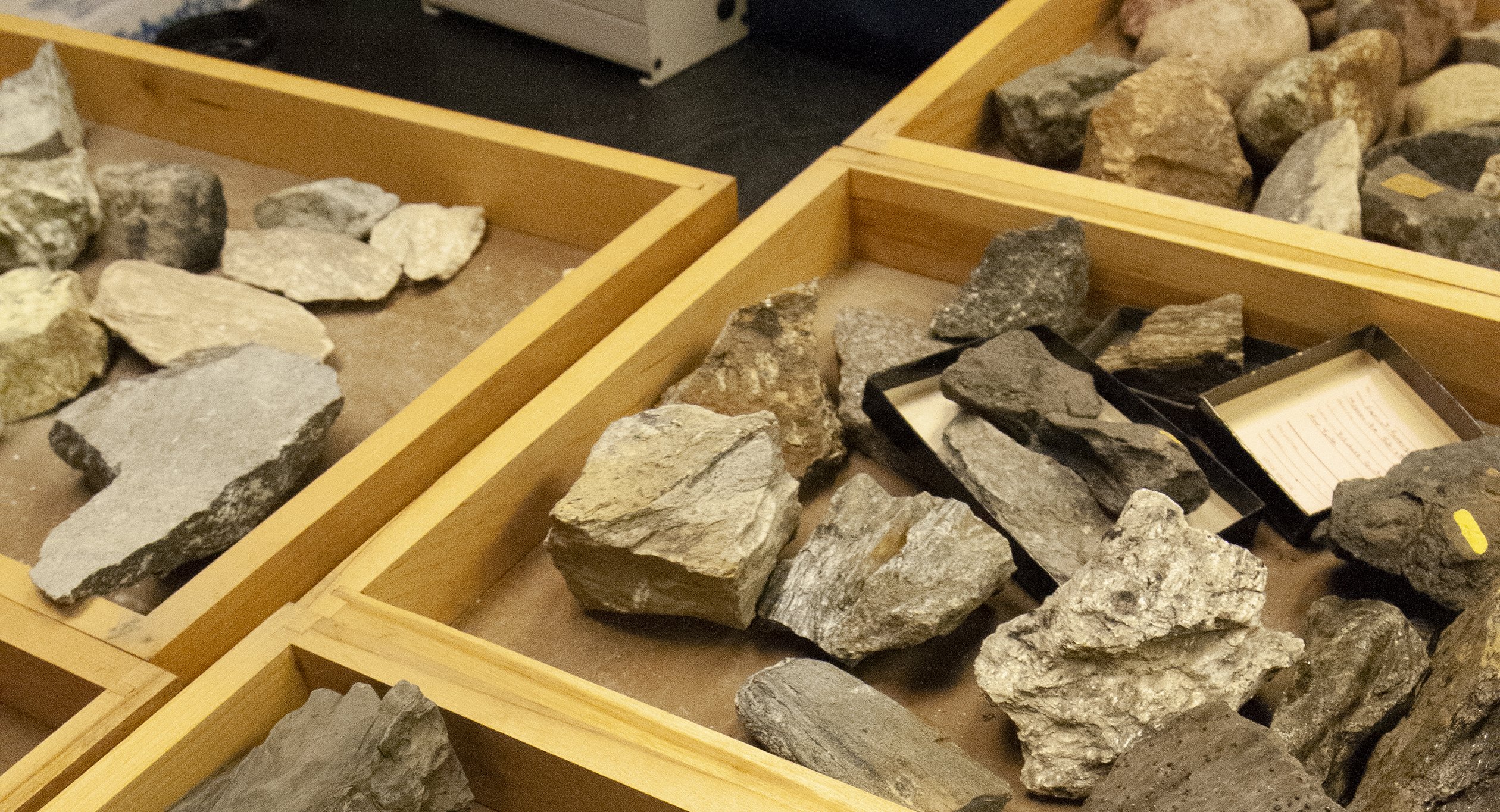
- rock cutting and thin-sectioning equipment and microscopes for petrographic analysis;
- a gravimeter and a collection of local- to continental-scale topographic and geologic maps and aerial photographs for structural geologic studies.
A $1.7 million grant from NASA to UC was used to update and expand the college's science teaching and research resources. From this the geology department added instrumentation to support coursework and faculty and student research in paleolimnology, paleoceanography and paleoclimatology; including
- sediment coring equipment and a small inflatable raft for lake and wetland sampling and monitoring,
- a YSI in-situ multisensor water quality probe,
- an integrated suspended sediment sampler and bottom sediment grab sampler,
- a Malvern automated sediment grain size analyzer,
- Bartington whole-core and discrete-sample magnetic susceptibility meter,
- Ortec gamma detection system for radiometric dating of sediment cores, and
- ArcGIS geographic information systems (GIS) software.
Total credit hours required for degree: 120 (BA), 128 (BS)
ACADEMIC REQUIREMENTS
(See also General Education Core)
| Course | Credit Hours | Year Taken | |
|---|---|---|---|
| Core | 34-55 | ||
| Major Course Requirements | |||
| Foundations of Geoscience | |||
| Geology 115 | Elementary Oceanography | 3 | 1,2 |
| Geology 225 | Physical Geology1 | 4 | 1,2 |
| Geology 226 | Historical Geology | 4 | 1,2 |
| Geology 325 | Mineralogy | 4 | 2,3 |
| Geology 373 | Sedimentology and Stratigraphy | 4 | 3,4 |
| Geology 398 | Structural Geology and Tectonics | 4 | 3,4 |
| Geology 410 | Geoscience Seminar (taken twice) | 1x2 | 3,4 |
| One of the following: | |||
| Geology 313 | Introduction to Paleobiology | 4 | 2,3 |
| Geology 323 | Hydrology and Society | 4 | 2,3 |
| Geology 333 | Weather and Climate | 4 | 3,4 |
| 29 | |||
| Major-Related Course Requirements | |||
| Chemistry 211 | General Chemistry I | 4 | 1,2 |
| Mathematics 112 | Basic Statistics | 3 | 1,2 |
| Physics 151 or 261 | General Physics I or Physics I2 | 4 | 2,3 |
| 11 | |||
| Total Credits: | 40 | ||
| Additional Course Requirements | |||
| B.S. in Geoscience | |||
| Chemistry 212 | General Chemistry II | 4 | 2,3 |
| Geology 326 | Petrology | 4 | 2,3 |
| Mathematics 201 | Calculus I | 3 | 2,3 |
| Mathematics 202 | Calculus II | 3 | 2,3 |
| Physics 152 or 262 | General Physics II or Physics II2 | 4 | 3,4 |
| Electives in CHE, ENV, GOL, MAT, or PHY at or above 300-level | 6-8 | 3,4 | |
| Capstone Experience in Geoscience - Select one the following: | |||
| Geology 450 | Research in Geoscience | 3 | 4 |
| Geology 460 | Field Experience in Geoscience3 | 3 | 4 |
| Geology 470 | Internship in Geoscience | 3 | 4 |
| 27-29 | |||
| B.A. in Geoscience | |||
| Biology 211 | General Biology I | 4 | 2,3 |
| Environmental Science 201 | Introduction to Environmental Issues | 3 | 2,3 |
| Physics 116 | Astronomy: A Study of the Universe | 3 | 2,3 |
| 10 | |||
| Electives | |||
| The student must complete sufficient elective courses to earn at least the minimum credit hours required for this degree, and at least 64 credit hours of the 128 required for the B.S. or at least 90 credit hours of the 120 required for the B.A. must be in the liberal arts and sciences. | |||
1 Some students may develop an interest in geoscience while taking GOL 105 for Core. In such instances, students may substitute GOL 105 for GOL 225 by also successfully completing GOL 225 Lab while registered for 1 credit of GOL 390.
2 For students interested in continuing on to graduate studies in earth and environmental science, the calculus-based physics courses PHY 261 and 262, for which MAT 201 Calculus II is a pre-requisite, are highly recommended.
3 The field course may be taken external to the college and the credits transferred. The department will maintain a list of pre-approved field courses and will consider others by petition.
Top