Carl Lohmann

Carl Lohmann
Director of Student Conduct and Community Standards
(315) 792-3363

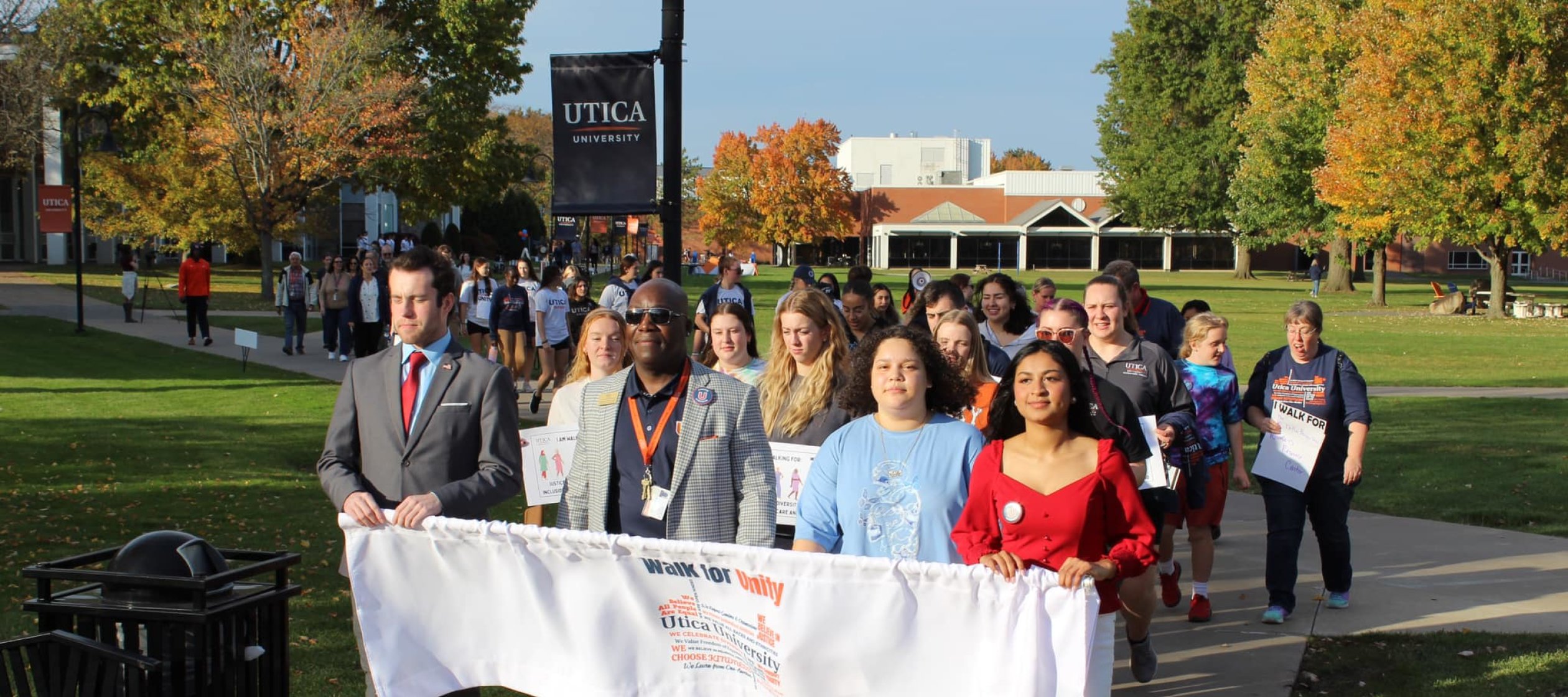
The Utica University Student Conduct Program is intended to support the mission of the University through educating students about appropriate behavior and fostering a community where academic success can occur. The Program seeks to inspire the development of future leaders and responsible citizens by engaging in responsible and ethical decision-making. Students are treated with respect, and expected to take appropriate responsibility for their behavior, and the behavior of those around them.
"Human development is the aim of student conduct."
Utica University Code of Student Conduct
Utica University is a community committed to the pursuit of knowledge, meaningful academic experiences, and intellectual growth. In order to serve these goals, we recognize that we have a responsibility to create an inclusive community in which all of its members feel valued, as well an obligation to build a community that affirms, cherishes, and sustains freedom of expression.
We acknowledge that this balance is sometimes difficult to maintain and that, even though there are some clear legal precedents regarding protected forms of expression, the boundaries of allowable expression are nonetheless sometimes unclear, situation-specific, and subject to contestation, particularly in moments of crisis. Further, we contend that it is frequently precisely those ideas that challenge, frustrate, trouble, and offend some members of the community that may most advance the pursuit of knowledge. Therefore, the faculty and students, the administration and staff, and the Board of Trustees of the University have a duty both to maintain a system of tolerance and civility so that all of us feel empowered to participate in the sometimes-difficult discourse of an academic community, and to protect the precious heritage of freedom of thought and expression.
As an institution of higher education Utica University has a mission and a responsibility to encourage the widest possible discussion of ideas that bear on the development of our students and the enhancement of the larger society. In the classroom this principle is essential to the academic enterprise. Outside of the classroom, in both curricular and extracurricular venues, the goals of our purpose as an academic institution are best served by breadth of discussion and tolerance for controversy and disagreement. We embrace the intellectual challenge of confronting difficult, complex, and controversial ideas. This must be balanced with the necessity of providing an environment that is free of harassment to members of our student body and our larger community, so that a sense of marginalization and powerlessness does not frustrate the very goals we pursue. As we recognize and seek to expand the rich diversity of our students and employees and the varying cultures, backgrounds, and experiences we bring to the University, we find it essential to articulate our commitment to creating, maintaining, and promoting an environment where our similarities and differences are respected and valued.
In all of our principles we should also be mindful of the fact that we are an academic community that exists for the specific purpose of developing, testing, and teaching advances of knowledge and understanding. While we must be tolerant of the purveyors of a wide array of views, the University has no good purpose to be served by the advancement of factually inaccurate information. Ideas, beliefs, values, and aesthetic judgments that are offered up to the University community, or that are current in the wider public discourse, will be scrutinized and judged by the University community according to the standards of evidence and reason, and may be subject to repudiation and rejection based on that evaluation.
To these ends Utica University urges community members to recognize the following principles:
We know that our understanding and use of these principles will necessarily evolve over time as our experiences as a community and as individuals change and grow. We put forth this Statement of Principles not as an end in itself, but as a dynamic document intended to reflect and affirm the values and principles most integral to who we are as an educational institution and the experiences we believe all of our members deserve to have.
Utica University, in adopting this Statement of Principles, also acknowledges its duty to take steps to protect the physical safety of our community. Nothing in this Statement shall serve to limit the University's ability to make decisions designed to meet that obligation.
When an incident is documented, reports are forwarded to the Office of Student Conduct & Community Standards. If there is determination that a violation of the Code of Student Conduct has occurred, a charge letter to the student(s) involved is generated. The student charged with the violation(s) will be referred to either a Student Life Administrator or the Director of Student Conduct & Community Standards. The hearing officer to which the student is referred is based on a student's conduct history and the severity of the alleged violation. A hearing will proceed to determine the responsibility of the student.
Following a hearing, the student will receive a Sanction Notification Form. The student is responsible for signing and returning the last page of the form back to the Office of Student Conduct & Community Standards. If a student does not sign the Sanction Notification Form or indicate a desire to appeal within 72 business hours of receipt of their letter, this indicates their acceptance of the outcome.
If the student is found responsible for violating the Code of Student Conduct, but believes the outcome isn't appropriate, he or she may request an appeal by indicating this option on the Sanction Notification Form. The Office of Student Conduct & Community Standards will then contact the student to set up an appeal hearing with Director of Student Conduct & Community Standards or the Student Conduct Appeal Board. The student will receive written notification of the outcome of their appeal.
When an incident occurs in the residence halls, reports are reviewed by the Office of Student Conduct & Community Standards. Violations that are likely to result in a warning and educational sanctions are referred back to the building Assistant Director. Violations that are likely to result in the student being removed from the residence hall or repeated violations of previous behavior are referred to the Assistant Director of Student Living or the Director of Student Conduct & Community Standards.
The Assistant Director of Student Living will schedule a hearing with the student to discuss the incident and determine responsibility. If appropriate, the Assistant Director of Student Living or the Director of Student Conduct & Community Standards will then determine the resulting point assignment and sanction(s).
Incidents that take place outside of the residence halls will be heard by the Director of Student Conduct & Community Standards. The student will receive a charge letter that outlines the alleged violation(s) of the Code of Student Conduct, provides information regarding student rights and responsibilities, and gives the student a date and time for their hearing with the Director of Student Conduct & Community Standards.
During an administrative hearing, the Director of Student Conduct & Community Standards explains to the student the conduct process and the Code of Student Conduct violations outlined in the charge letter. This is also an opportunity for the accused student to explain his/her side of the story, indicate whether he/she is willing to take responsibility for violating the Code of Student Conduct, and provide information from pertinent witnesses. During this meeting, charges may also be dropped or amended.
At the outcome of the hearing, if the student is found responsible for the violation(s) of the Code of Student Conduct, the Director of Student Conduct & Community Standards will then determine the point assignment and sanction(s); and a sanction letter is generated. The student is responsible for signing and returning the Sanction Notification Form to the Office of Student Conduct & Community Standards. If the student has been found responsible for the violation and wants to appeal, they have 72 business hours from receipt of the sanction form to notify the Office of Student Conduct in writing.
The Student Conduct Appeals Board is a hearing body comprised of students, staff, and faculty. This Board hears appeals of cases decided by the Director of Student Conduct & Community Standards. This is the only venue for appeals of decisions at this level.
When a student wishes to appeal a decision made by the Director of Student Conduct & Community Standards, he or she will return their sanction letter to the Office of Student Conduct & Community Standards indicating the reason for the appeal and a written statement supporting their reason. The Office of Student Conduct & Community Standards will schedule an appeal hearing with the Student Conduct Appeals Board, and notification of the hearing will be sent to the student. Prior to the appeal hearing, the student is strongly encouraged to set up an appointment with the Director of Student Conduct & Community Standards to talk through the appeal process. After the appeal hearing is complete, the student will receive a letter outlining the decision made by the Board.
The University has jurisdiction over all alleged violations of the Code of Student Conduct by any student(s) or student organization(s) that may be brought to its attention. Jurisdiction extends to alleged misconduct that takes place on University-owned or controlled property and alleged misconduct that takes place at any University sponsored event when it has a significant impact on the educational mission and well-being of The University or well-being of a student or student organization. Jurisdiction may also extend to off-campus incidents when the alleged incident adversely affects members of The University community, interferes with the daily lives of local residents, and/or jeopardizes The University's positive public relationship with the community/public. Jurisdiction may also be extended if The University is made aware of a pending incident that occurred prior to admission that could adversely affect members of The University community, interfere with the daily lives of local residents, and/or jeopardize The University's positive public relationship with the community/public.
The Dean of Students/designee may assign an interim action(s) upon learning of potential violations, if the allegation(s) of misconduct is apparently reliable and relates to the safety and/or welfare of any person, University property, or any University function. The assignment of an interim action(s) restricts the student from certain privileges at the University in the interest of safety and/or the wellbeing of the community or the student themselves; it does not mean the student has been found responsible for violating the Code of Student Conduct. Interim actions can include (1) modification or suspension of the ability of a student to be present in specific areas or buildings on campus; (2) modification or suspension of the ability of a student to be present on University property in its entirety; (3) modification or suspension of the ability to attend class(es); (4) modification or suspension of the ability to participate in a University-related activity; or (5) the issuance of a No Contact Restriction. The interim action(s) will be communicated in writing to the student, by email or in person and is effective immediately. Failure or refusal to take receipt of notification will not negate or postpone said interim action. Interim actions are in effect from the time of issuance until the Dean of Students/designee determines that the reason for imposing the interim action no longer exists and the student receives written notice that the interim action is no longer applicable or until the resolution of the student conduct matter through the Student Conduct Process.
The safety of our students is of the utmost importance to Utica University. For that reason, Utica University has a Medical and Good Samaritan Amnesty policy that assures students will always seek out the appropriate assistance of Campus Safety staff, Student Living staff, or local medical first responders in a time of medical or psychological distress for themselves or other members of The University community resulting from the use of alcohol and/or drugs.
Any individual including friends, witnesses or a third parties, who shares information in the interest of any individual's health and safety will not be subject to assignment of points or disciplinary action by The University for their own personal consumption of alcohol or other drugs at or near the time of any incident, provided they did not harm or place the health or safety of any other person at risk. The University may require an educational meeting where support, resources, and educational counseling options may be discussed and potentially required for an individual who has engaged in the illegal or prohibited use of alcohol or drugs.
Failing to seek assistance for a member of The University community in medical need may have dire consequences for the person in need of assistance. Sanctions for students who fail to seek assistance or interfere with an individual's attempt to get assistance will be severe.
A student may request a pre-hearing to review the conduct process with an administrator. The Hearing Officer will cover how the process ties to the Code of Student Conduct, where documentation comes from, how charge letters are generated, and what kinds of rights students going through the Utica Student Conduct Process are afforded.
The purpose of a hearing is to document the student's "plea" (Responsible or Not Responsible) and to determine whether they're responsible for the alleged violation(s). If a student accepts responsibility, discussion of the student's actions as well as sanctions may take place. If the student pleads "Not Responsible", his or her perspective will be discussed and any additional information that the student provides will be used by the hearing officer to make an informed decision. The student will receive the hearing officer's decision by email.
While the process of an appeal hearing with an administrator or the Student Conduct Appeals Board (hereafter referred to as "Board") is fairly similar to the process followed in original administrative hearings, there are some key differences. These differences include:
You may only appeal based on one or more of the following:
Venue
"Venue" refers to where and with whom a hearing takes place. The venues available for appeal are based upon where the initial hearing took place. Appeal venues are as follows:
Director of Student Conduct Appeal Hearings
The Director of Student Conduct will hear appeals of Student Living hearing officer decisions. An appeal hearing date and time is scheduled, and the Director of Student Conduct & Community Standards will review the documentation and meet with the student to discuss the basis for his/her appeal. The student will receive notification of the Director's decision by email.
Student Conduct Appeals Board Hearings
The Student Conduct Appeals Board consists of several student, staff, and faculty members. For an appeal hearing to take place, (a) at least three members of the Board must be present, and (b) a representative from each of the following College constituencies must be present - 1 student, 1 staff member, and 1 faculty member.
The Student Conduct Appeals board will hear appeals of the Director of Student Conduct & Community Standards' decisions. An appeal hearing date and time is scheduled, and the Board will have the opportunity to review the appeal hearing materials before the hearing takes place. The board will ask the student to leave the room while they deliberate, and will call the student back in to deliver their decision.
As an institution, Utica University is committed to providing a safe and secure living and learning environment for all members of our community. Utica University expects each student to uphold our community’s values, norms, and expectations, and Utica University’s Student Conduct program emphasizes each student’s responsibility for themselves and to other members of their community.
Integral to the Code of Student Conduct and our Student Conduct program is the connection to the University’s core values. Integrity, respect for the person and property of others, and a commitment to intellectual and personal growth in a diverse population are values deemed fundamental to membership in this college community. The goals of the Student Conduct program include a commitment to fostering a sense of community that allows every member to comfortably live, work, and study in an atmosphere of mutual respect, providing a conduct process in which there is the opportunity for participants to experience personal growth and appreciation for the responsibilities of living in a community, and assisting students in developing alternatives to inappropriate behavior. As a result, students will be held accountable for behavior that violates our Code of Student Conduct.
Utica University has developed a point system for use in sanctioning students that are found responsible for violations of the Code of Student Conduct. This point system is designed to provide clarity, predictability, and consistency in the sanctioning process. Assigned point values reflect the level of severity for each possible violation of the Code of Student Conduct. The system also tracks a student’s conduct history. If a student continues to violate the Code of Student Conduct, their point total rises to reflect their conduct history. Point totals are cumulative within a single incident as well as over a student’s academic career at Utica University.
For example, if a student is found responsible during the first week of the semester for underage consumption of alcohol, they will be assigned 4 points for the incident. If the same student is then found responsible for failure to follow emergency procedures later in the semester, they will be assigned 4 points for that violation for an accumulated total of 8 points. Students can consult the table of violations to see what points will be assigned for certain violations as well as how points will accumulate based on future violations.
In addition to assignment of points, students will face a system of educational sanctions, notifications, and restrictions. When students are found responsible for violations and their point totals reach the following levels; either from one incident or multiple incidents; the following notifications or restrictions will take place (as well as educational sanctions at each level):
Students will be assigned points based on violations. Other sanctions will occur at the point levels identified and can also include sanctions for lower point totals (i.e.: If a student is reaches 7 points, they can be assigned ten hours of campus service as well as any restrictions listed for 6 points). Any sanction listed above that is not applicable to a certain student (i.e.: Residential Probation for a student who does not live on campus) will be replaced by an equivalent sanction.
In our example describing the point system, the student was assigned 4 points for an incident of underage consumption of alcohol. At that time, they would receive a Written Warning, be asked to complete a Judicial Educator related to violation and write a reflection paper, and perform Five hours of campus service. Later in the semester when they were found responsible for failure to follow emergency procedures, they were assigned 4 points for that violation giving them a total of 8 points. At that time, (less than 90-days from their first violations), the student will be placed on Residential Probation if applicable and be given an educational assignment that explores their educational and career goals or a specific topic based on the violation. They would be penalized in the housing selection process and perform five more hours of campus service and be assigned an AOD assessment with Counseling staff for AOD violations. The student will not be eligible for Greek Life or Study Abroad, and will be placed on social restriction or social probation. The student could also be placed on Disciplinary Probation and a notification will be sent to the student’s parent(s) or guardian, success coach, and athletic coach will be notified of their violation(s).This notification occurs because the student is very close to the 10 point threshold for suspension or expulsion.
Students may have points forgiven in three ways:
A two-point reduction will occur 90 days after the assignment of points. Students must complete all sanctions by their date due and not be found responsible for any other violations during the 90-day time period. If a student does have another violation, a two-point reduction will not occur until 90 days after the most recent violation (with no further violations occurring).
A one-point reduction will occur for those students who have had an AOD violation if they complete the Alcohol EDU program and complete a reflection paper. This paper must be substantive and approved by the assigning hearing officer. Students will only be eligible to receive this particular reduction one time.
A two-point reduction will be given with the completion of an approved 10-hour service project that is overseen by the Director of Student Living or their designee. The Director of Student Living or their designee will approve, monitor progress, and verify completion of the aspects of the Residential P.R.I.D.E campaign. Upon completion, the student will need to write a reflection paper describing the project, the lessons learned throughout the project, and the positive impact the project had on the residential community. Students will only be eligible to receive this particular reduction one time per academic semester.
In our example describing the point system, the student was assigned 5 points for their first incident; 1 point for the noise violation and 4 points for the underage consumption of alcohol. The student decided to complete the Alcohol EDU program and a reflection paper. This provides the student a 1-point reduction and leaves them with a total of 4 points. Unfortunately, they were found responsible for failure to follow emergency procedures prior to 90 days passing. They were assigned 4 points for that violation giving them a total of 8 points (invoking the restrictions at the 6-point, 7-point, and 8-point notifications). Shortly after this incident, the student decided to complete an approved 10-hour community service project in cooperation with an off-campus agency and write a reflection paper. Upon completion and approval of the project and the paper, the student receives a 2-point reduction from their total resulting in a new point total of 6 points.
Below is a listing of most violations of the Student Code of Conduct and the assigned point values. This list is not exhaustive nor inclusive of all possible violations.
Below is a listing of most violations of the Student Code of Conduct and the assigned point values. This list is not exhaustive nor inclusive of all possible violations.
| Points | Violations |
|---|---|
2 |
|
3 |
|
4 |
|
5 |
|
6 |
|
8 |
|
10 |
|
| Points | Violations |
|---|---|
2 |
|
6 |
|
| Points | Violations |
|---|---|
6 |
|
8 |
|
10 |
|
| Points | Violations |
|---|---|
1 |
|
2 |
|
3 |
|
4 |
|
5 |
|
6 |
|
8 |
|
10 |
|
| Points | Violations |
|---|---|
1 |
|
2 |
|
8 |
|
Note:
Revised August 2023
Utica University is committed to the maintenance of an environment that is supportive of its primary educational mission and free from exploitation and intimidation. Utica University will not tolerate rape, sexual assault, or any other form of non-consensual sexual activity, hereafter referred to more broadly as sexual misconduct. This policy is intended to articulate the University’s stance on sexual misconduct, define sexual misconduct and the concept of consent, and outline the procedure followed by the University in the event that an incident of sexual misconduct occurs. The University will enforce this policy through internal conduct procedures, safety programs, and the exploration of and support for prosecution of alleged offenders through the appropriate external judicial forums. The University supports this policy for students, faculty, and staff through its educational programs and counseling services.
Sexual misconduct includes the following behaviors:
*Student members of the University community found to be in violation of this policy are subject to the conduct action outlined in the Student Handbook and clarified in the more detailed policy to be found in offices listed below. A student who is found to have violated the University’s Code of Student Conduct may receive penalties up to and including removal from University housing and/or dismissal from the University. Pending a final judgment, the University reserves the right to exclude from University property any student whose presence it regards as a threat to the safety and welfare of any individual.
*Staff, faculty, and employees found to be in violation of this policy are subject to disciplinary actions including, but not limited to, termination. Visitors and/or invitees to the Utica University campus found to be in violation of this policy shall be prohibited from coming onto the Utica University campus.
Dealing with Difficult Students
Oneida County YWCA Domestic and Sexual Violence Services, (315) 797-7740
Alcoholics Anonymous, (315) 732-6880
Addictions Crisis Center, (315) 735-1645
Center for Family Life and Recovery, (315) 733-1709
Community Recovery Center, (315) 334-4701
Insight House Chemical Dependency Services, (315) 724-5168
The following are toll-free information and referral services:
Alcoholism Council of New York, 1-800-56-SOBER
National Cocaine Hotline, 1-800-COCAINE
Substance Abuse and Mental Health Services Administration, 1-800-662-HELP
The role of the Procedural Advocate is to assist the student before, during, and after the conduct process. The Procedural Advocate is not an adversarial role, and is not to speak on behalf of the student during any conduct hearing.
If a student, rather than the University, has filed a complaint against a student, both the responding student and the complaining student are entitled to a Procedural Advocate. Procedural Advocates may be any member of the Utica University community (except staff from the Counseling Center and Office of Student Living).
Student Procedural Advocates are expected to adhere to all provisions of the Utica University Code of Student Conduct. If you are charged with any violation of the Code of Student Conduct, or with a criminal offense this will make you ineligible to continuing serving as a Procedural Advocate.
If you will be serving as a Procedural Advocate, you are expected to attend all scheduled meetings and any training sessions for which you are given advance notice, or meet with the Director of Student Conduct prior to serving.
A Procedural Advocate is expected to maintain the confidential nature of the conduct process, especially in terms of any information shared and/or discussed throughout the process. If information is knowingly revealed, the Director of Student Conduct reserves the right to remove the person from the Procedural Advocate role and take conduct action.
If you are interested in serving as a Procedural Advocate, please contact the Director of Student Conduct & Community Standards, Carl Lohmann, calohman@utica.edu
Q: What are my rights and responsibilities as a Utica University student?
Utica University is a community, and every member of our community shares responsibility for its continued well being.
As a Utica University Student, you have the right to expect a campus environment that supports your learning and personal growth. At the same time, we expect that you will be guided by the values that we deem fundamental to our mission - values such as integrity, respect for others, and a commitment to intellectual and personal growth in a diverse community. These values are reflected in the Student Rights and Responsibilities and Code of Student Conduct sections of Utica University’s student handbook. The Utica University catalog includes additional information regarding issues of academic integrity.
Q: What is the Code of Student Conduct?
The Utica University Code of Student Conduct details what is expected of you as a member of the Utica University community. It also outlines behaviors that are in conflict with those expectations and with the values of this institution. The Code of Student Conduct may be found in its entirety online at www.utica.edu/handbook and on this website under the Code of Student Conduct. In brief, we expect that you will:
Q: Why did I get a letter?
This simply means that the Office of Student Affairs has received a report indicating that you may have been involved in behavior that violated the Utica University Code of Student Conduct. The charge letter provides you with information about the situation in question, the date on which it occurred, and the parts of the Code of Student Conduct that pertain to that incident. Your letter will also contain information about meeting with a hearing officer or board.
Q: What is the difference between the Utica University Student Conduct Program and the external legal system?
While there are some similarities, Utica University’s Student Conduct Program is focused on education. That means it varies from the legal system in the following ways:
Q: My friend met with a Student Living staff member. Why am I meeting with the Director of Student Conduct & Community Standards?
The venue for your hearing will depend on factors such as your conduct history, the impact your behavior may have had on the community, the degree to which your safety or the safety of others was at risk, and/or your level of involvement in the incident. For more specifics, see the explanation of levels of violations and sanctions.
Q: What if I don’t show up for my hearing?
If you do not appear for your hearing, the hearing officer or board has the right to determine the outcome of your hearing in your absence.
Q: What rights do I have in the student conduct process?
Any student charged with violating the Code of Student Conduct has the right to fair process at Utica University. That means that you have the right to the following:
Q: What are the possible outcomes of a hearing?
Consequences (called sanctions) for being found responsible for a violation of the Code of Student Conduct can take the form of a written warning, probation, or in the most serious situations, suspension/expulsion from the residence halls or the University. All sanctions are focused on education and helping the student change their behavior.
Q: What is a likely sanction?
Your sanction will be determined based on a variety of factors including your level of offense and conduct history. Please see the information provided on sanctions and the point system, above.
Q: What happens if I don't do my sanction?
Failure to complete and comply with any and all sanctions will result in a hold being placed on your student account. This will affect your ability to take any action through several offices of the University.
Q: How many chances do I get?
Utica University does not follow the "three strikes and you're out" philosophy, although you cannot continue to violate the Code of Student Conduct indefinitely. Utica University's Conduct program includes the philosophy of progressive discipline, and hearing officers/boards also balance care for the individual student with the needs of the larger community. That means that a series of what appear to be less significant incidents may result in your being asked to leave the community. There are a number of factors that determine your sanctions if it's been determined that you are responsible for violating the Code of Student Conduct.
Q: How does an appeal work?
An appeal provides you with the opportunity to have a decision about your responsibility in an incident or the sanction imposed reviewed by a hearing officer. In order to appeal a decision made by a hearing officer, you must indicate that you wish to appeal within 72 business hours and provide a written statement with information about why you are appealing. If both the sanction form and the written statement are not turned in by the specified due date (72 business hours from when you receive your sanction notice) you lose your right to appeal. For more information, see the section on appeals, above.
Q: Will my parents find out?
FERPA (The Family Educational Rights and Privacy Act) does limit the information we can share with others, including your parents, although there are exceptions, particularly if you are a dependent and/or under 21.
Utica University believes that students should be able to make mistakes and learn from them, and that you are accountable for your own behavior. Because of this, we do not necessarily notify your parents if you have been charged through the Student Conduct program.
However, if a pattern of behavior or a singular incident means that your safety is at risk, that you have put others at risk, and/or it is possible that your status as a student will change, the appropriate staff member will notify your parents.
Q: What are the long-term effects of being found responsible for violating the Code of Student Conduct?
Generally, minor violations will really have no long-term impact. A more serious violation and sanction can have significant long-term impact on you. Graduate schools and some jobs typically look for a pattern of inappropriate behavior. It is generally acknowledged by most colleges and universities that testing limits and making mistakes are part of the “college experience.” However, if you aren’t able to show how you've learned from these incidents and changed your behavior over time, this will likely impact your ability to get hired or attend graduate/professional school.
Q: Who has access to my conduct records?
Conduct records are confidential and are used for internal use only. A third party does not have access to these records without your written consent. While you may on occasion sign a waiver permitting us to share information from your files, we do not release copies of information except under specific circumstances (such as a subpoena).
Q: How can I complete documentation, and who can file a complaint?
A complaint can be submitted in either written form or online.
If you choose to submit an incident report in writing, you will need to get a documentation form from Campus Safety, fill it out, and either return it to Campus Safety or the Office of Student Affairs. Documentation forms are also available through the Office of Student Living, and on under Forms, above.
If you choose to submit an incident report online, you will need to go to coco.utica.edu/MyCoCo. Once there, you will need to log in (username-community, password-utica1) and follow the instructions on the screen. Once you are finished completing the report, please make sure to review it, and click submit before closing out of the system.
Any member of the community can submit documentation against a student/organization alleging a violation of the Code of Student Conduct. If you have any questions about submitting documentation, please do not hesitate to contact the Director of Student Conduct in the Office of Student Affairs (Carl Lohmann, calohman@utica.edu).
You can also submit documentation anonymously via e-mail at utica@tipnow.com or by phone at 315-505-8470.
Q: How long do I have to provide written documentation?
While there is no hard deadlines for submitting documentation, the best information is gathered as soon as possible.
If you are trying to decide whether or not to provide documentation, please speak with someone in The Office of Student Life, The Office of Student Living, or Campus Safety as soon as possible.
Q: Who can I talk to if I’m unsure about filing a complaint or have a question about the process?
There are many resources available to you if you are unsure about filing a complaint.
Any questions about submitting a complaint/documentation, or about the Student Conduct program can be addressed directly with the Dean of Students. Also, staff members in Campus Safety, Student Living, or The Office of Student Life can talk with you about your concerns and about whether filing a complaint is appropriate.
Q: In what circumstances can a student be held accountable for off-campus behaviors?
If a student engages in behavior that violates the Code of Student Conduct at a University sponsored event, or on University owned or controlled property, the University will act to address that behavior through the Student Conduct program.
In addition, jurisdiction may extend to behavior that has a significant impact on the well-being of a student or student organization, or that which affects the educational mission and well-being of the University, even if it occurs off-campus at an event, or in a place not controlled by Utica University. Intervention in these cases is at the discretion of the Dean of Students.
Q: What does it mean to be a witness?
The most essential role of being a witness is to provide information that is relevant to help determine whether or not the charged student is responsible for the alleged violations they have received. Witnesses are essential in order to ensure that the hearing officer/board has the best picture possible of what occurred during the incident in question.
Q: What will I have to do?
As a witness, you will be asked to provide accurate information regarding the incident regarding-what you know, who was there, and what you saw. It is likely that you will be asked to fill out written/online documentation. If the student who is charged will be having a board hearing, you will be asked to attend that hearing. If the hearing will be an administrative one, you may be contacted by the administrator who is conducting the hearing in order to talk further about what you know about the situation.
If you have any questions at any time about the process or your role, read the section on Hearing Process, above, for additional information and/or contact the Dean of Students.
Q: Will the student who has been charged know that I provided documentation?
Students being charged and going through the Student Conduct program have the right to know what information is being used to make decisions about responsibility, as well as who provided that information. While we can begin an investigation of a situation and keep witness names confidential, when the hearing process begins, the charged student will have information about the origination of any information being used in the conduct process.
If you experience any form of retaliation as a result of providing written or online documentation, please contact Campus Safety immediately (x3046). Utica University does not tolerate retaliation, and any student who engages in behavior that is/could be considered to be retaliation will be charged through the Student Conduct Program.
Q: Do I have to see the student that I provide information about?
In a board hearing, the charged student is in the room when witnesses come in to speak with the board. Charged students are not to attack any witness(es), and will be instructed to direct all questions for the witness(es) to the Chair of the Board.
In administrative hearings, witnesses are not in the room during the hearing process, although the hearing officer may request additional information from witnesses based on the charged student's response to documentation.
Q: How can I support my son/daughter through the Student Conduct Process?
Even though your son or daughter is the person most actively involved in the process, there are a variety of ways you can be supportive:
Q: Will I be called when my son/daughter is charged with a violation of the Code of Student Conduct?
In most situations, we will deal directly with your son or daughter if they have been charged with a violation of the Code of Student Conduct, and will not directly contact you. While we understand you want to be in the know, we do believe that students have the right to make mistakes and learn from them. Most of the situations resulting in conduct action tend to be relatively minor in scope.
The times when we will make a point to contact you are when (a) your son’s or daughter’s safety is at risk; (b) your son’s or daughter’s ability to reside on campus or continue as a Utica University student is in jeopardy; or (c) a pattern of behavior has been established that is likely to put your son or daughter at risk of continuing at Utica University, and working with you as a partner in changing your son or daughter’s behavior would be productive. We are also more likely to contact you if your son or daughter is a minor at the time.
When possible, we encourage your son or daughter to speak with you first, so that you can have the conversation with them before we contact you.
Q: Why can’t I have access to my son or daughter’s conduct record? I pay tuition!
There are both philosophical and legal reasons for not sharing this information with you.
Philosophically, we believe that students are learning to be adults while they are at Utica University, and that means they need to take responsibility for their actions both in and outside of the classroom. As a result, our system is constructed to deal directly with the student rather than parent.
In addition, student educational records, which include conduct files, are protected under the Family Educational Rights and Privacy Act. This means that the student needs to give permission for anyone other than themselves to view the information contained in their file. If your son or daughter gives us permission, we can and will talk with you about the details of the incident that resulted in your son or daughter being charged with violations of the Code of Student Conduct.
We are also concerned with protecting the privacy of other students who may or may not have been involved in that particular situation, as their information is also contained in any documentation.
Your son or daughter has access to this information at any time, and should have copies of any information he/she submitted in the course of investigating the alleged behavior.
Q: Can I attend my son/daughter’s hearing?
No. You certainly may support your son or daughter by talking with them before or after the hearing, but the Student Conduct process is a closed process which only includes members of the Utica University community. While a student may have a Procedural Advocate present with them, that advocate must be a member of the Utica University community.
For a general list of frequently used logins, you can also visit our logins page.